
139 Canadians per Federal Employee
Few governments or leaders want to be measured against this

Taking a break from the Middle East this week and back to Canada.
The Federal government has recently released its plan on public service job cuts across departments.
According to BNN Bloomberg:
The Canada Strong Budget 2025, released in November, outlined a plan to reduce the size of the federal public service by 28,000 positions by 2029, including 16,000 full-time equivalent (FTE) positions eliminated.
Nearly 15,000 full-time equivalent positions will be cut in federal departments over the next three years, as part of the federal government’s plan to find $60 billion in savings by 2029.
We wrote about the “good times” won’t last
About a year and a half ago, we wrote about the dramatic increase of Federal employees over the past decade.
This chart showed the trend:
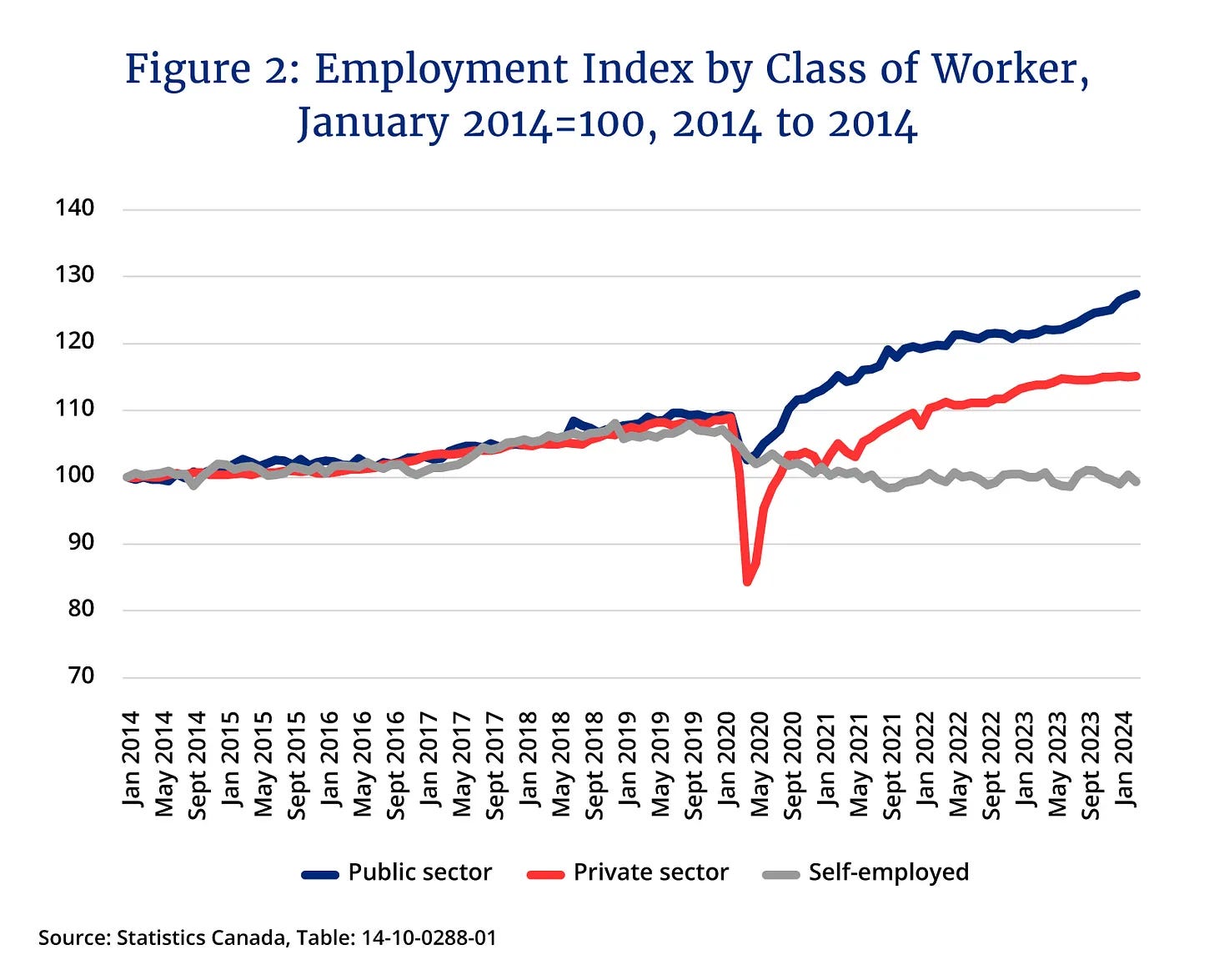
Source: The Hub
You can read it here: https://www.ecresearchgroup.com/p/reading-tealeaves
That bloat was one of the biggest driving forces behind the real estate gains in cities like Ottawa for many years.
We predicted the tailwind would end with a change of government.
We anticipated a different government in Ottawa at the time.
But when the problem of a bloated government becomes large enough, not even the Carney government can look the other way.
Well operated businesses monitor their KPIs
Peter Drucker, the father of modern management, once said:
What gets measured gets improved.
KPIs, or Key Performance Indicators, are simple tools with a profound impact on any organization or individual seeking to make progress.
A health coach would encourage their clients to track their sleep, diet, and exercise.
A financial advisor would help their clients track their total debt, income, net worth, and annual portfolio returns.
As citizens, we should expect the same discipline from the people spending our tax dollars.
Unfortunately, few governments or leaders want to be measured against anything that holds them accountable.
Since they are not going to do it for you, I will introduce one simple KPI worth tracking.
139 Canadians per Federal Employee
The metric is simple:
The number of Canadians for every Federal employee.
The lower the ratio, the less efficient the government.
It means it takes more Federal employees to provide services for the citizens.
On the other hand:
The higher the ratio, the more efficient.
139.
That is the number to remember.
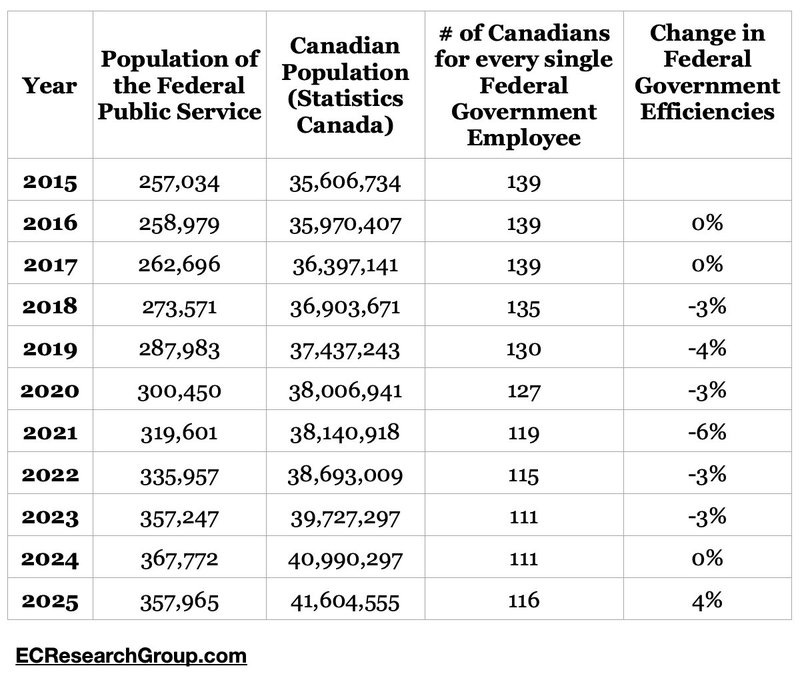
Between 2015 and 2017, the Canadian Federal government was able to function effectively with 139 Canadians for every single Federal employee.
Since then, the efficiency has quietly collapsed.
The ratio fell from 139 all the way down to 111.
A 20% decline in efficiency, with no measurable improvement in the quality of life for Canadians.
I put together a table illustrating what a bloated government looks like from the lens of Federal payroll numbers:
Think about that for a moment.
More employees.
Bigger government.
Larger deficits.
And the average Canadian is no better off than we were in 2015.
Trending in the right direction
By 2029, the Federal government is projecting a reduction of 28,000 employees from the payroll.
Accounting for slower population growth, the ratio could improve to approximately 129 Canadians per Federal employee.
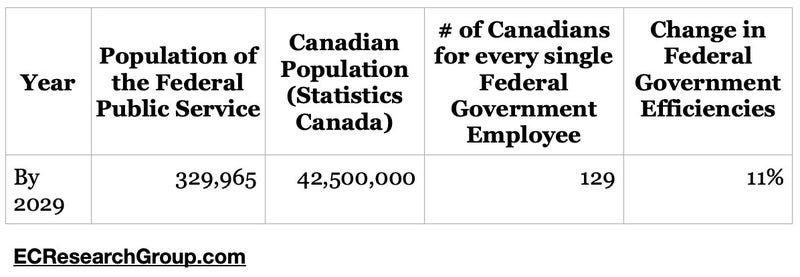
Still short of the 2015 benchmark at 139.
But at least the trend is finally moving in the right direction.
Here is an interesting data point for comparison.
The United States government operates with 2.4 million Federal employees serving a population of 342 million.
That puts the American citizen to Federal employee ratio at 143.
In other words, the US Federal government currently runs more lean than Canada does, significantly more.
That should give every Canadian taxpayer pause.
The cuts being announced are a step in the right direction.
But a step is not a destination.
139 is the number we want back.
Watch it closely.
Better yet, forward this newsletter to your MPs.
Hold them accountable.
Until we get back to 139.
If you like my work, I invite you to share it with others.
Eric Chang
Calgary, Alberta, Canada
March 24, 2026
Copyright © 2026 EC Research Group.
No part of this publication may be reproduced, distributed, or transmitted in any form or by any means, including photocopying, recording, or other electronic or mechanical methods, without the prior written permission of the publisher, except in the case of brief quotations embodied in critical reviews and certain other noncommercial uses permitted by copyright law.
The information provided herein is believed to be accurate and reliable, but EC Research Group does not guarantee its accuracy or completeness. The content is for informational purposes only and is not intended to be a substitute for professional financial advice. EC Research Group is not a financial advisor and does not provide personalized financial advice. The views and opinions expressed in this publication are those of the author and do not necessarily reflect the official policy or position of EC Research Group. The content may be subject to change without notice and may become outdated over time. EC Research Group is under no obligation to update or revise any information presented herein.
Investments involve risks, and individuals should consult with a qualified financial advisor before making any investment decisions. Prospective investors should carefully consider the investment objectives, risks, charges, and expenses of any investment before investing.