
A 3 Trillion Dollar bounced check
The market doesn't seem to care

As we enter the third week of the US-Israel-Iran war, one question remains unanswered:
What exactly is the objective?
Is it handicapping Iran’s military? Is it destroying Iran’s nuclear capability? Is it locating enriched uranium and removing it from the country? Is it regime change?
Nobody seems to know.
If you’re wondering, you’re not alone.
Google searches such as “why is us at war with Iran” or “why are we at war with Iran” popped up as popular searches on Google US website:
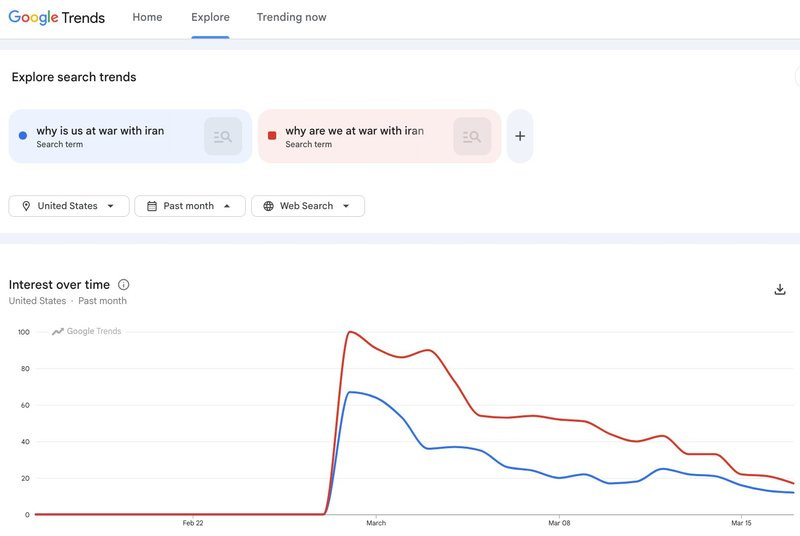
Image Credit: Google Trends
While the US and Israel appear to be winning on the battlefield, the Iranian regime has quietly opened a second front.
The IRGC (The Islamic Revolutionary Guard Corps) understands something the White House or Pentagon may not:
You don’t beat the US military by fighting it directly.
You beat it by hitting where it hurts most: the November US midterm election.
Destroy the world’s economy. Force Trump’s hand. Let the American voter do the rest.
Unlike the US, which runs on democracy, Iran operates under strict authoritarian rule. Iranian citizens may endure a harsh standard of living against their will. Americans have no such patience.
Especially when gas prices start climbing at the pump.
The biggest irony in all of this?
No one knows what the US is trying to accomplish in Iran.
Meanwhile, Iran’s objective couldn’t be clearer:
Disrupt the world economy. Force Trump’s hand.
The market doesn’t seem to care
The Iran conflict is the most serious military engagement the United States has entered since the Iraq War in 2003.
Oil prices spiked overnight.
Yet if you check your stock portfolio this morning, you’d barely notice anything happened.
Doesn’t that strike you as strange?
A war of this scale, one escalating from military strikes to full economic warfare, the S&P 500 has “only” dropped 4.7%?
As someone who studies patterns and connects dots for a living, this kind of behavior gets my attention immediately.
When something stops acting “normal,” I lean in.
Because in my experience, the market doesn’t ignore reality forever.
It just delays the reaction, and then overreacts all at once.
A less reported war
The Iraq War happened when I was much younger, more than 20 years ago.
I don’t remember all the details.
What I do remember is the media coverage.
The footage. The constant updates. The sense that the whole world was watching.
Contrast that to today.
Iran is currently under a complete internet blackout. The Iranian regime is suppressing coverage while top government leaders are being eliminated by airstrikes.
At the same time, Iran is executing what I’d call a chaos strategy - a deliberate attempt to destabilize the world’s and the Gulf’s economy.
By firing missiles into Dubai, Iran didn’t go after oil.
They went after something far more valuable to the UAE (United Arab Emirates).
90% of their population
So far, have you noticed how little footage we’ve seen from Dubai?
There’s a reason for that.
Dubai is now charging tourists for filming Iranian missile strikes. According to a recent report from The Guardian, a British tourist was among 20 people charged over videos documenting the attacks:
The UAE government is deeply concerned about one thing above all else:
Fear spreading.
And people packing their bags.
Here’s what most people may not know about Dubai:
Around 90% of its population are foreigners. That’s over 10 million expats living and spending in the country.
Many wealthy expats have been scrambling to leave the country.
In private jet charter groups, messages were circulating during the early days of the conflict:
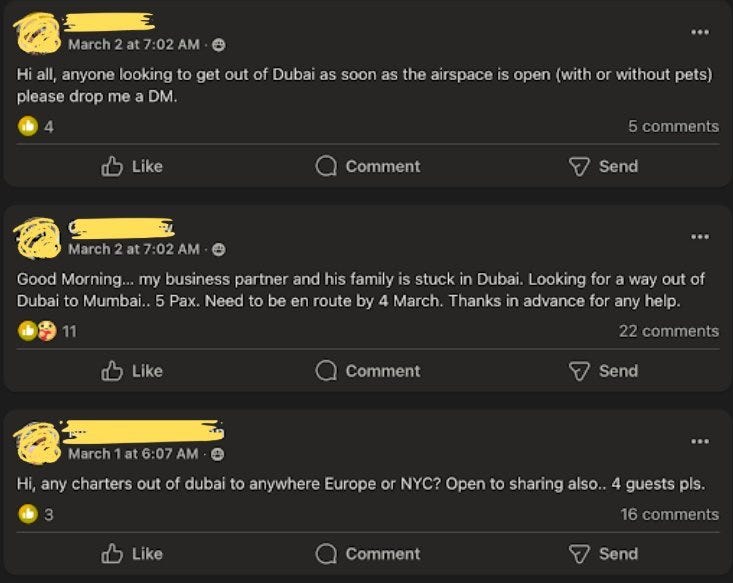
Even if only a fraction of these expats taking a break from Dubai, the economic impact would be significant.
Wealthy expats don’t just take their luggage with them.
They take their spending. Their businesses. And most importantly, their capital elsewhere.
A 3 Trillion Dollar bounced check
Here’s where this story gets interesting for investors.
The Gulf countries have been significant investors in the United States for decades, to the tune of approximately $2 trillion.
The six Gulf countries’ eleven sovereign wealth funds invest about $2 trillion in the U.S, which is over 35% of their total assets under management. Thse countries invest in U.S. stocks, bonds, alternative investments such as hedge funds, real estate, and infrastructure. Over 25% of the total Gulf investments in the U.S. are in equities and about 17% are in fixed income products, especially U.S. Treasuries.
That’s an enormous anchor of capital supporting American markets and financial assets.
But the bigger number isn’t the $2 trillion already invested.
It’s the $3 trillion in future commitments that Trump celebrated as one of his signature deals.
You have to give it to Trump, he is a deal maker.
But anyone who has done a lot of deals knows one simple truth:
No deal is final until the money is in the bank.
If Iran’s chaos strategy continues to rattle the Middle East, and more expats begin leaving, the Gulf countries may find themselves urgently focused on stabilizing their own domestic economies before writing checks to America.
From the same Forbes article:
Where Gulf countries have more influence is in threatening not to buy anymore U.S. stocks and bonds and in canceling the $3 trillion investment commitments they promised last year. If Gulf sovereign wealth funds were to undertake such actions, they would be signaling to the world that they are prepared to use their investment muscle to push the U.S. and Israel to end the Iranian conflict.
That $3 trillion check?
It may bounce before it’s ever cashed.
There will be damage to the economy
Just because we don’t see or hear about the war as much, it doesn’t mean it’s not happening.
Iran’s chaos strategy is running in the background: quiet, deliberate, and patient.
The disconnect between what markets are pricing in and the real economic damage being done by this conflict means only one thing:
When most investors finally wake up to the reality, they will be caught off guard.
And when they rush for the exits, all at once, the market will move fast.
This war is far from over.
Even if the military conflict ends in the coming weeks, the economic war could continue for months.
We’ve written before about the importance of liquidity. About keeping dry powder ready not because you’re fearful, but because you’re strategic.
This is exactly the kind of environment that rewards patience.
The investors who hold liquidity today will be the ones positioned to find genuine value in the months ahead.
When others are forced to sell, you want to be the one ready to buy.
The market may not be paying attention right now.
But the smart money is watching closely.
Are you?
If you like my work, I invite you to share it with others.
Eric Chang
Cardston, Alberta, Canada
March 17, 2026
Copyright © 2026 EC Research Group.
No part of this publication may be reproduced, distributed, or transmitted in any form or by any means, including photocopying, recording, or other electronic or mechanical methods, without the prior written permission of the publisher, except in the case of brief quotations embodied in critical reviews and certain other noncommercial uses permitted by copyright law.
The information provided herein is believed to be accurate and reliable, but EC Research Group does not guarantee its accuracy or completeness. The content is for informational purposes only and is not intended to be a substitute for professional financial advice. EC Research Group is not a financial advisor and does not provide personalized financial advice. The views and opinions expressed in this publication are those of the author and do not necessarily reflect the official policy or position of EC Research Group. The content may be subject to change without notice and may become outdated over time. EC Research Group is under no obligation to update or revise any information presented herein.
Investments involve risks, and individuals should consult with a qualified financial advisor before making any investment decisions. Prospective investors should carefully consider the investment objectives, risks, charges, and expenses of any investment before investing.