
Alberta's 79k in job creation
#2 in Canada while most of the country stayed flat

Ask anyone involved in the real estate industry.
It has been a tough couple of years in Canada.
If you are in Alberta, our economy and real estate market are doing much better than the rest of the country.
Sometimes, it is good to look around to truly appreciate what we have here in Alberta.
Canada was in a technical recession this year
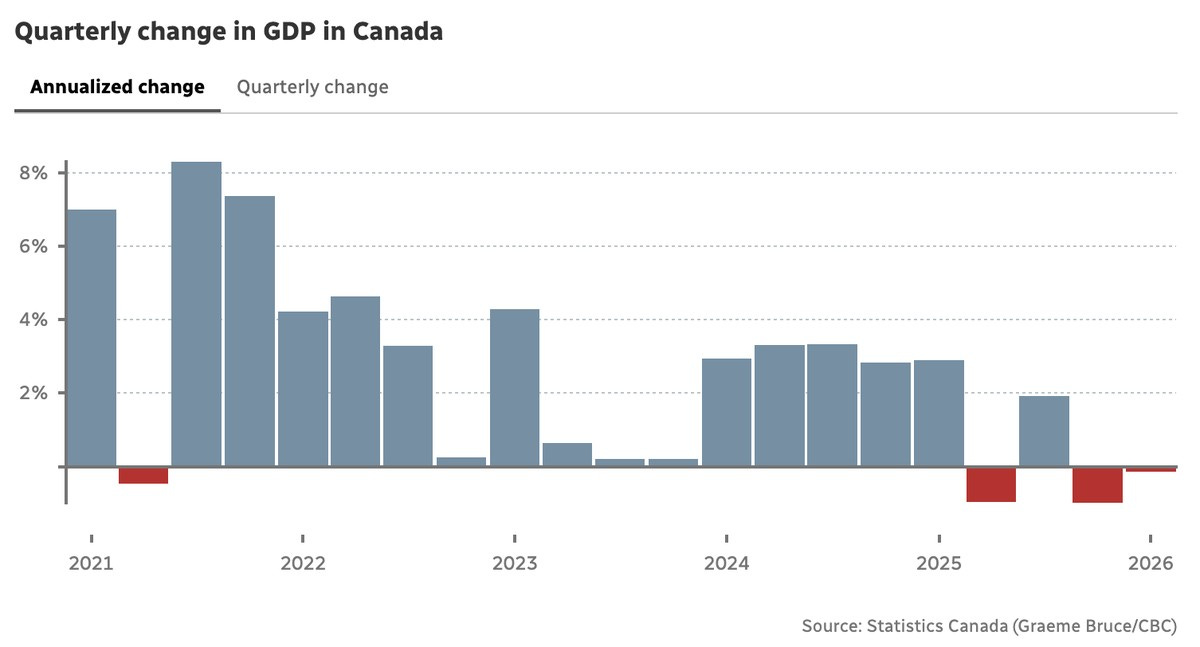
In the first quarter of 2026, Canada’s GDP contracted by 0.1 per cent.
That came after another contraction of 1 per cent in the fourth quarter of 2025.
Two consecutive quarters of declining GDP is defined as a recession, counting Canada’s economy as a technical recession.
Over the past year, provinces such as Quebec and British Columbia lost jobs in the tens of thousands.
Meanwhile, most of the Provinces in Canada had a flat job market.
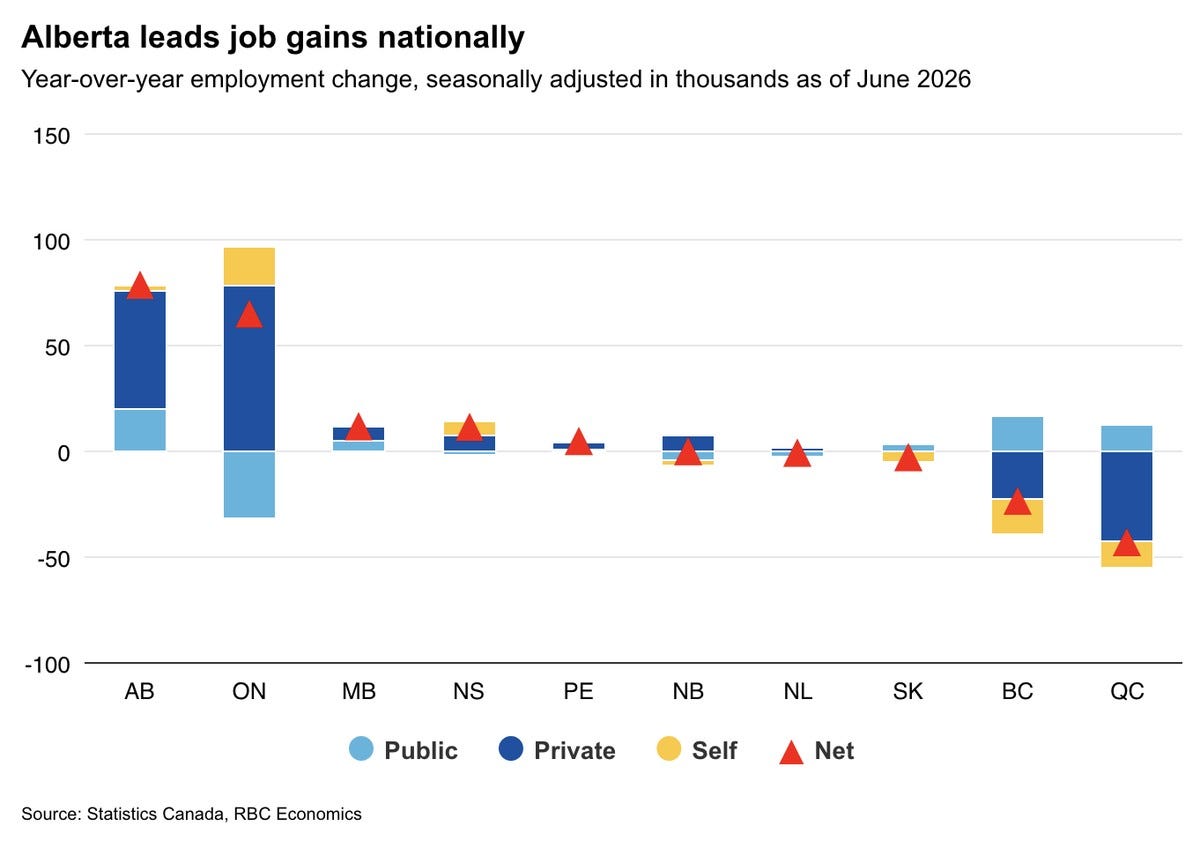
PEI, Alberta and Ontario were the three outliers.
Ontario added roughly 65,000 jobs, adjusting for population, it represented only an increase of approximately 0.8 per cent.
Alberta added about 79,000 positions.
That represented an impressive 3 per cent increase.
In other words, Alberta’s job market grew nearly four times faster than Ontario’s on a population-adjusted basis.
We wrote about how high unemployment numbers were masking the impact of record migration
Back in October 2024, we wrote about how Alberta's higher unemployment rate was not necessarily an indication that the economy was struggling.
If we zoom out, we’ll see what’s happening is completely normal.
With the historic influx of people moving to Alberta in the past couple years, the jobs market are taking some time to adjust.
The increase in unemployment rate is a reflection of people moving to Alberta and not able to find a job, today.
Source: https://www.ecresearchgroup.com/p/alberta-unemployment
In contrary to what the “unemployment” number may suggest, the higher unemployment rate was a result of record migration in modern Alberta history since the previous oil boom 20 years ago.
We also wrote about how the government would eventually play catch up on creating more public sector jobs
Alberta is “notoriously” for being fiscal conservative compared with most other Provinces.
That means, just because we have an influx of new Albertans, the government is taking its time to increase its hiring.
[...] we’re going to see lots of angry Albertans complaining about the Government services getting degraded with the population increase.
Which has already happened in the area of health care and education.
We will see more hiring from the Alberta Government in the coming years.
Over the past year, Alberta added 55,000 more jobs in health care and social services between June 2025 and 2026.
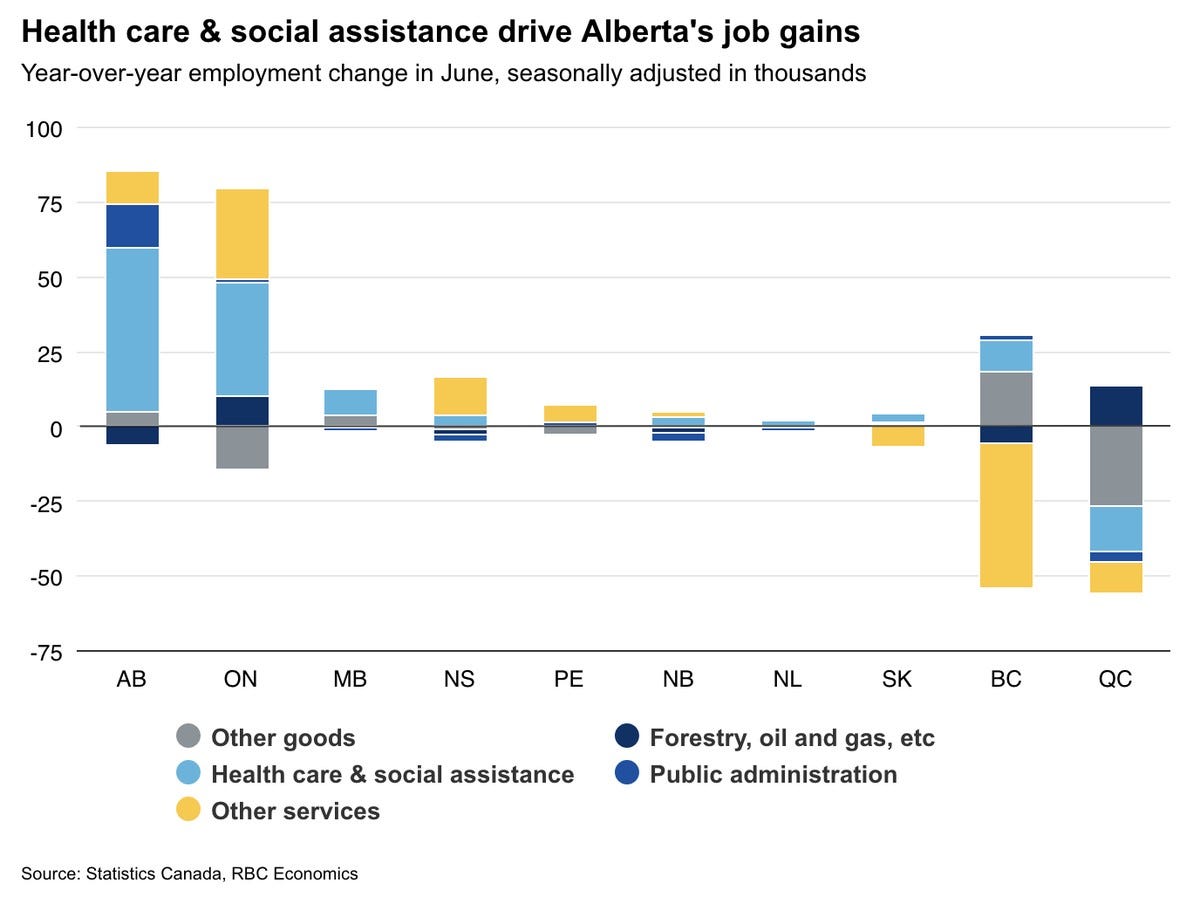
Alberta’s healthcare workforce has now caught up
2 years ago, we made the prediction that the Government of Alberta will ramp up hiring in the health care jobs and increase public sector employment.
Today, we’re seeing that showing up on the data.
With a significant increase in health care positions between June 2025 and June 2026, Alberta has now caught up and now lead many Provinces by the number of health care and social workers to every citizen.
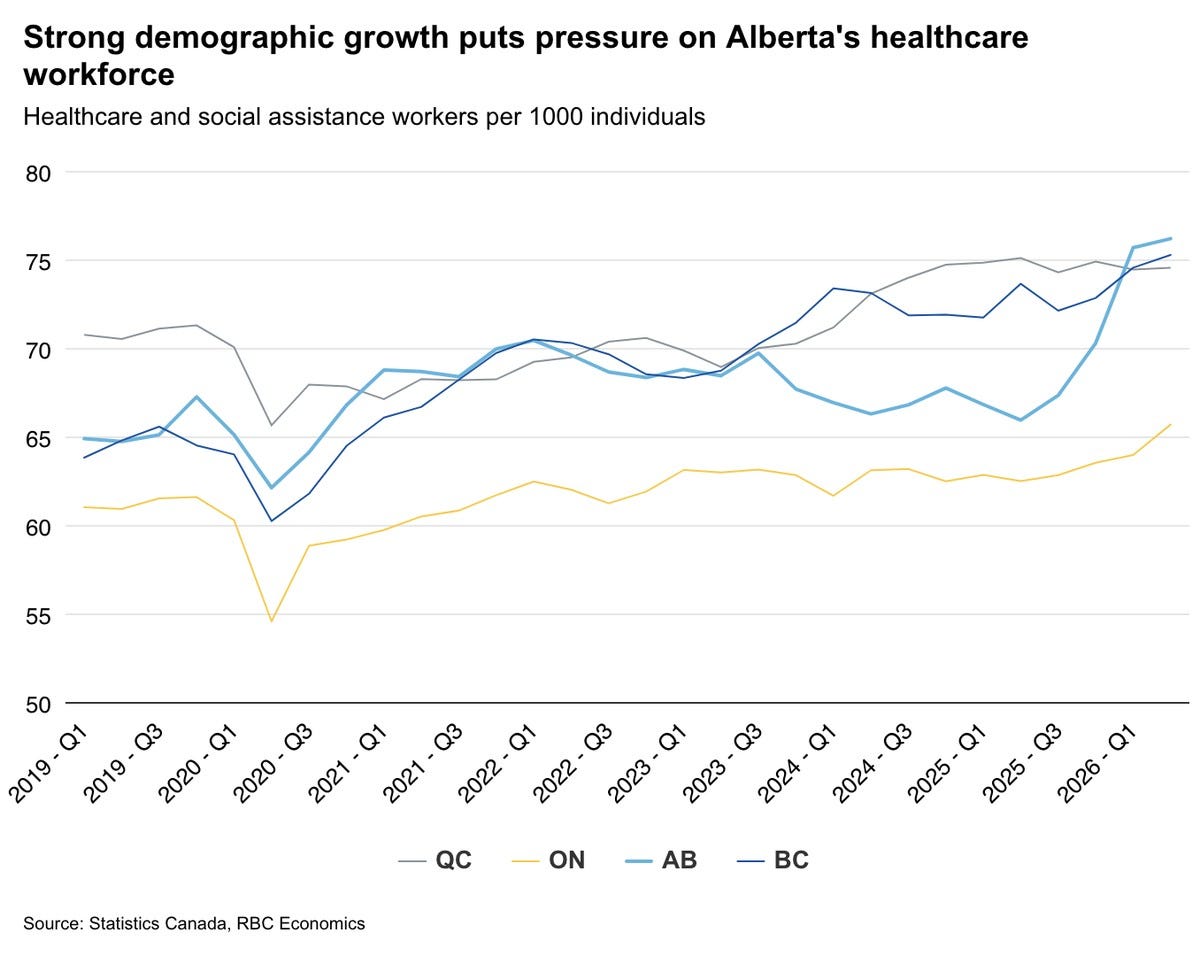
That is important for two reasons.
First, it supports the quality of life for the people who already live here.
Second, it removes one of the major constraints created by rapid population growth.
Preparing Alberta of the next phase of population and economic growth.
Next up: Private sector job creation
Now that the health care workforce has largely caught up compared to other Provinces, Alberta’s future employment growth may become more dependent on the private sector job creation.
Other than the Meta data centre in Sturgeon County, some major projects are either delayed or still working through the approval pipeline.
For example, Dow’s Path2Zero project in Fort Saskatchewan was estimated to create 6,000 construction jobs at its peak.
The project has now been delayed to 2029.
The Pathways Plus carbon capture and storage project, combined with the West Coast Oil Pipeline, is forecasted to create more than 175,000 new jobs in Alberta, British Columbia and across the country.
You can read more about the project here:
Pathways Plus CCS and West Coast Oil Pipeline
For the next decade, Alberta’s economy is well positioned to lead in the job creation front in the country.
Alberta is still well positioned for the next decade
When it comes to Alberta real estate, for the next couple years, it warrants some cautiousness due to macroeconomic conditions such as a persistent higher interest rate.
That being said, real estate always comes back to two core drivers:
Jobs and population growth.
Based on what’s on the horizon, the outlook for both remains stronger in Alberta than in most of the country.
Especially when we look further out to 2028 and beyond.
If you like my work, I invite you to share it with others.
Eric Chang
Victoria, British Columbia
August 11, 2026
Copyright © 2026 EC Research Group.
No part of this publication may be reproduced, distributed, or transmitted in any form or by any means, including photocopying, recording, or other electronic or mechanical methods, without the prior written permission of the publisher, except in the case of brief quotations embodied in critical reviews and certain other noncommercial uses permitted by copyright law.
The information provided herein is believed to be accurate and reliable, but EC Research Group does not guarantee its accuracy or completeness. The content is for informational purposes only and is not intended to be a substitute for professional financial advice. EC Research Group is not a financial advisor and does not provide personalized financial advice. The views and opinions expressed in this publication are those of the author and do not necessarily reflect the official policy or position of EC Research Group. The content may be subject to change without notice and may become outdated over time. EC Research Group is under no obligation to update or revise any information presented herein.
Investments involve risks, and individuals should consult with a qualified financial advisor before making any investment decisions. Prospective investors should carefully consider the investment objectives, risks, charges, and expenses of any investment before investing.