
Carney went back to his investment banker roots
Canada's first national sovereign wealth fund

Mark Carney just made his most ambitious move yet.
Last week, the Prime Minister announced the creation of Canada’s first national sovereign wealth fund.
According to BNN Bloomberg:
The federal government will initially contribute $25 billion into the fund, which Carney says “will grow through asset recycling and reinvestment, creating even greater opportunities for future generations.”
Purpose of sovereign wealth fund
A sovereign wealth fund is a government-owned investment fund designed to grow national wealth.
The most well-known examples are Norway’s Government Pension Fund Global, Abu Dhabi Investment Authority, and Singapore’s GIC. These funds have one shared objective: deploy capital strategically to generate long-term returns for the nation.
Think of it as a country investing for its retirement.
The best-run sovereign wealth funds operate quietly in the background, compounding returns across decades. They buy stakes in infrastructure, real estate, technology companies, and resource projects around the world.
For example, Norway’s Government Pension Fund started with 2 billion NOK (approximately US$300 million to $320 million at the time) in May 1996. It has since grown to over $2.2 trillion US today.
The underlying logic is simple. A government with surplus capital can put it to work, just like any disciplined investor would. The returns benefit future generations, not just the current one.
Sovereign wealth fund funding
Here’s where it gets interesting.
Historically, sovereign wealth funds were built on budget surpluses and resource revenues. Norway’s fund, arguably the most successful in the world, was seeded entirely from oil revenues. Abu Dhabi’s was funded the same way.
The formula is straightforward: earn more than you spend, invest the surplus, and let compounding do the rest.
Most financial advisors or personal finance coaches would outline a similar playbook for building personal wealth:
Pay down non-business debt (consumer debt)
Invest the surplus
Compound wealth from investments
The keyword in step two is surplus.
Last time I checked, Canada has been running a budget deficit for around 10 years.
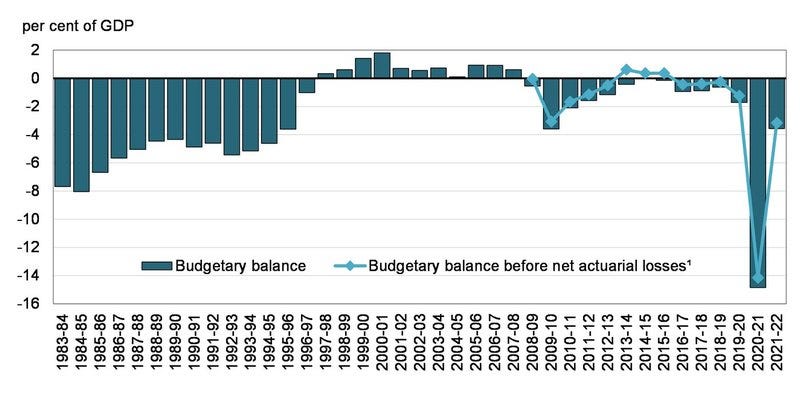
Source: Government of Canada
I find it a bit ironic to start a sovereign wealth fund while running a significant deficit. Can you imagine the famous personal finance personality Dave Ramsey telling his radio show listener:
“Don’t worry about paying down your debt. Start investing for your retirement.”
That’s not a wealth-building strategy. That’s a leveraged bet.
To be fair, not every sovereign wealth fund was launched from a position of surplus. Some governments chose to build their funds through borrowing or asset monetization. But those come with higher-risk.
Logic behind launching Canada’s sovereign wealth fund
Here’s where Carney lean into his investment banking background.
A sovereign wealth fund typically allocates majority capital into equity investments.
It invests as an owner, taking equity positions in projects and companies. That ownership stake is not just about returns. It’s also about what that ownership unlocks.
Using real estate investing as an example. A property investor puts in a 20% down payment, that’s the equity, and a bank lends the remaining 80%. The bank is willing to do this because real estate is considered low-risk collateral. The leverage amplifies the investor’s return on equity.
Now apply that same logic to a Government of Canada-backed sovereign wealth fund.
When the federal government is the equity owner of a project, banks and institutional lenders look at that investment very differently. The implied backing of a sovereign nation dramatically reduces perceived risk. That translates into lower borrowing costs, better terms, and higher leverage capacity.
This creates a situation where the equity returns out perform the underlying debt. Potentially resulting in a better outcome compared to managing personal finance and investments.
Carney spent years at Goldman Sachs and then the Bank of Canada and Bank of England. He understands capital structure better than most politician in the country. This announcement has his fingerprints all over it.
Whether it ultimately benefits Canadians depends on execution, investment discipline, and the kinds of projects the fund chooses to back.
That’s a different question.
I’m cautiously optimistic, however, I’m not oblivious by the fact that Government of Canada has made many poor investment decisions in the past.
Many due to political agenda over actual merits of investments.
If you like my work, I invite you to share it with others.
Eric Chang
Tokyo, Japan
April 28, 2026
Copyright © 2026 EC Research Group.
No part of this publication may be reproduced, distributed, or transmitted in any form or by any means, including photocopying, recording, or other electronic or mechanical methods, without the prior written permission of the publisher, except in the case of brief quotations embodied in critical reviews and certain other noncommercial uses permitted by copyright law.
The information provided herein is believed to be accurate and reliable, but EC Research Group does not guarantee its accuracy or completeness. The content is for informational purposes only and is not intended to be a substitute for professional financial advice. EC Research Group is not a financial advisor and does not provide personalized financial advice. The views and opinions expressed in this publication are those of the author and do not necessarily reflect the official policy or position of EC Research Group. The content may be subject to change without notice and may become outdated over time. EC Research Group is under no obligation to update or revise any information presented herein.
Investments involve risks, and individuals should consult with a qualified financial advisor before making any investment decisions. Prospective investors should carefully consider the investment objectives, risks, charges, and expenses of any investment before investing.