
Do these when the market feels overwhelming
Mastering the game of emotions

“Dow surges 1,100 points, S&P 500 posts best day since May as hopes grow for end of Iran war”
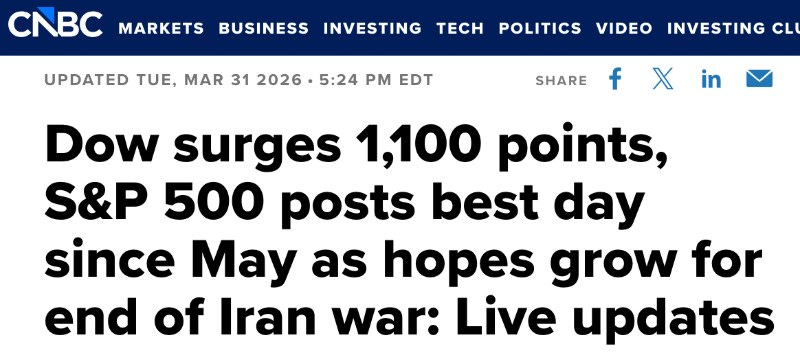
That’s the headline on CNBC today.
A nice big UP day after being down for most of last week and the month of March.
If the market is giving you motion sickness, I hate to be the bearer of bad news:
It’s not over yet. Better get used to it.
I grew up in an emotionally unstable environment
It’s hard to explain to people who don’t know what that environment is like.
The closest example may be the Hispanic soap drama.
Yes, TV shows are dramatized. But the reality of my upbringing isn’t far behind.
What does that have to do with investing?
I consider it my training ground.
That environment prepared me for the ups and downs of emotions. It helped me develop a wider emotional range than most people.
And more importantly, it taught me how to detach emotion from fact.
How to make difficult decisions while keeping the noise at bay.
That skill is worth more than any asset itself.
A common response to dramatic emotions
Most people are familiar with the fight or flight response.
Something sudden happens. The body reacts.
But there’s a third response that rarely gets talked about. And in my experience, it’s the silent destroyer of wealth:
Freeze.
Based on my observations of many investors over the years, freezing can be just as dangerous as panic selling.
Now, to be clear: this is not about right or wrong.
We don’t truly know how we’ll respond to any situation until we’re in it.
I’d love to proclaim I’m immune to freezing. I’m not. I’ve experienced it myself.
But awareness is the first step.
If you’re feeling paralyzed by the current market conditions, here are two tips from my own hard-earned lessons.
Tip #1: When you notice you’re frozen, consider this action
Take some capital off the table, for now.
Most investors get paralyzed by the binary: buy or sell.
When the information is overwhelming and the emotions are running hot, freezing becomes the brain’s way of coping. A way to defer the decision until later.
The problem?
The market doesn’t wait.
And that delay is often what does the most damage to a portfolio.
The shift I’d invite you to make: move away from “all or nothing” thinking toward “making room and slowing down.”
Instead of forcing yourself to decide right now whether to sell an investment, consider selling a smaller portion.
Professionals call this raising cash.
Taking some capital off the table, or selling a small % of portfolio to “raise cash,” it gives us room to breathe and allow the logical part of our brain to kick in.
We wrote about how powerful liquidity is during times of volatility. You can read it here: https://www.ecresearchgroup.com/p/cash-is-trash-but-liquidity-is-king
There’s a lot of psychology behind why we get stuck between buying and selling. Our own minds work against us.
But once you know what’s happening, you can sidestep the default programming.
Taking even a small amount off the table gives us room to breathe. It allows the logical part of our brain to re-engage.
Tip #2: Ask yourself this one question
Once you have some breathing room, once the limbic system has had a moment to reach homeostasis, the frontal lobe can do its job again.
That’s when I ask myself one important question:
Would I invest in this today, given everything I know right now?
Simple. Powerful. Often uncomfortable.
Because here’s the trap most people fall into: sunk cost fallacy.
The sunk cost fallacy is the irrational tendency to hold an investment based on how much time, money, or effort you’ve already put in, rather than its current merits.
It’s the “I can’t sell now, I’m already down” thinking that keeps people holding bad positions far too long.
Asking “would I invest today?” cuts through all of that.
It resets the question to what actually matters: the present reality, not the past decision.
Fair warning: you may not like the answer.
But that’s usually exactly the answer your portfolio needs.
Have you noticed your emotions with your investments lately?
It’s worth reflecting on.
Investing is emotional for most people. Because money is emotional for most people.
But it doesn’t have to be.
Money is a tool. It’s energy. It moves.
And the investors who can observe their emotions without being controlled by them, those are the ones who act when others freeze.
If you’ve been feeling the weight of this market lately, I hope these two tips give you something to work with.
The volatility isn’t going away.
But your response to it? That’s something you can train.
If you like my work, I invite you to share it with others.
Eric Chang
Calgary, Alberta, Canada
March 31, 2026
Copyright © 2026 EC Research Group.
No part of this publication may be reproduced, distributed, or transmitted in any form or by any means, including photocopying, recording, or other electronic or mechanical methods, without the prior written permission of the publisher, except in the case of brief quotations embodied in critical reviews and certain other noncommercial uses permitted by copyright law.
The information provided herein is believed to be accurate and reliable, but EC Research Group does not guarantee its accuracy or completeness. The content is for informational purposes only and is not intended to be a substitute for professional financial advice. EC Research Group is not a financial advisor and does not provide personalized financial advice. The views and opinions expressed in this publication are those of the author and do not necessarily reflect the official policy or position of EC Research Group. The content may be subject to change without notice and may become outdated over time. EC Research Group is under no obligation to update or revise any information presented herein.
Investments involve risks, and individuals should consult with a qualified financial advisor before making any investment decisions. Prospective investors should carefully consider the investment objectives, risks, charges, and expenses of any investment before investing.