

Last week, we discussed what I believe was the real reason behind the so called condo developers “bailout”: Carney isn’t bailing out developers
This week, let’s look at why I told people close to me that the “bailout” was coming, several months before Carney made the announcement.
I didn’t have a crystal ball. All I needed, was a calculator.
8% of total employment
Construction employment represents almost 8% of total employment in Canada. Residential and non-residential are split roughly evenly. (Source: CIBC Economics)
Eight percent.
That’s not a small number. That’s one in every twelve working Canadians tied, directly or indirectly, to something getting built.
Now ask yourself a simple question: What happens to an economy when one in twelve jobs starts to disappear?
No incentives to develop new condos
The math for a developer today is brutal.
I know, because I have been developing real estate for the past few years.
And I wasn’t even operating in the most challenging segment of real estate: Condo development.
The months of condo inventory keeps on rising. And while inventory piles up, the average condo price continues to drop.
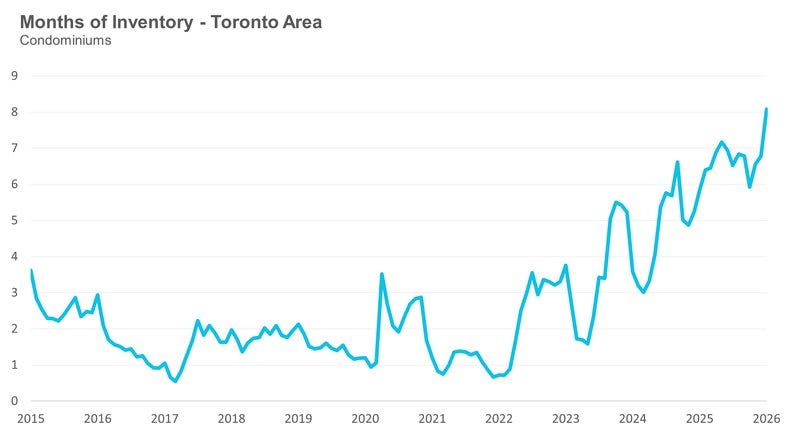
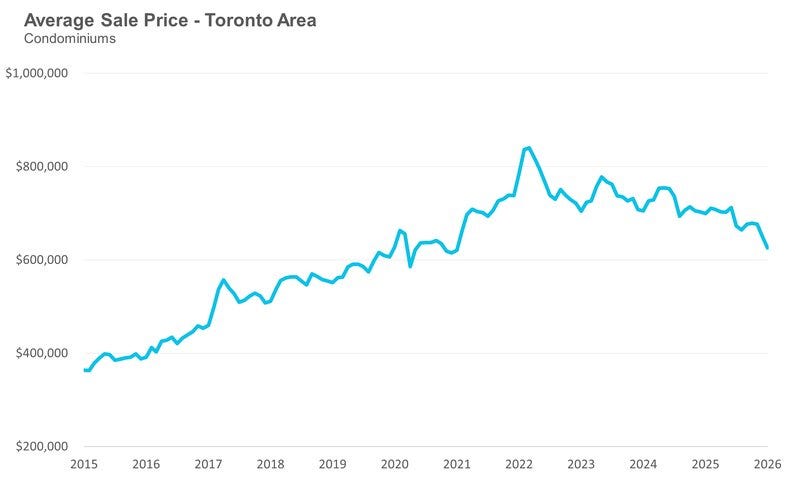
Credit: Move Smartly
Why would any rational developer break ground on a new condo project in this environment?
They wouldn’t. And they aren’t.
New condo starts plummets over 68%
The numbers here are staggering.
New condo apartment construction has plummeted in markets such as Toronto and Vancouver. The rolling 12-month total of starts fell to 10,583 units in July, down 60% from a year earlier and 68% below the mid-2023 record (August 2025 figures).
Can it go lower? According to RBC economists, yes it can.
The bank points out that in Toronto, condo pre-sales lead new starts by roughly 18 months. Pre-sales over the trailing 12 months dropped to just 2,160 units in July. Do the math forward and starts could collapse another 80% (Source: Better Dwelling)
This isn’t a slowdown.
We’re talking about the pipeline emptying out.
What are construction workers going to do after existing condo projects are completed?
This is the part Carney wants to say out loud.
The cranes you see in the sky today are finishing projects that were financed years ago. Those projects have a finish line.
So what happens the day after the last unit is handed over?
What happens to all those trades, contractors, machine operators, truck drivers?
On top of that, there are countless of consultants, loan brokers, commercial bankers, lawyers, realtors… all rely on taking on new condo projects to put food on their tables.
Who’s going to do any work in a condo market with rising inventory and falling prices?
The construction unemployment rate has already been trending higher
If the condo market stays depressed for the coming months and years, the construction unemployment rate is about to go higher.
Much higher.
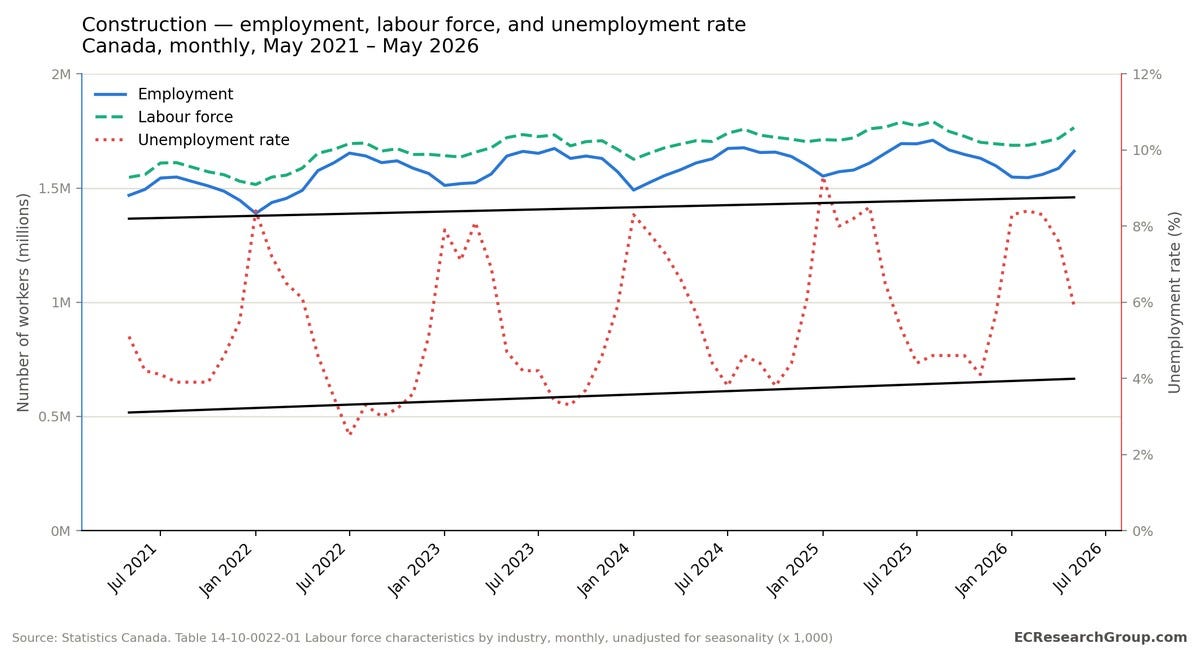
The timing makes it trickier. This isn’t a new problem. The construction unemployment rate has been trending higher since 2023.
And here’s something that may be keeping the Prime Minister up at night:
Even as we enter summer, the busiest building season of the year, the season when good weather should have crews working flat out, the unemployment rate for construction workers is already sitting higher than the same stretch in previous years.
If it’s already elevated during the good weather, what does it look like when winter comes?
It doesn’t take much for construction unemployment to push to 10% by coming winter.
The downturn in Toronto and Vancouver real estate markets is about to take Canada into a prolonged recession
Unless the real estate market stabilizes.
That’s the whole ballgame.
We’ve got 8% of employment leaning on construction. We’ve got housing starts collapsing. We’ve got a workforce with nowhere to go once current projects wrap up. And we’ve got an unemployment trend that’s been pointing the wrong direction.
Connect those dots, and the picture shows itself.
This is why I expected the “bailout” to happen. It was never really about rescuing developers who bet wrong on a project. It was about what sits underneath those developers, and what sits underneath the people they employ.
“Bailing out the developers” is only the beginning.
Trust me, that’s not the end of “Operation Bail Out.”
That’s the First Act.
I believe we’re only in the first half of “Operation Bail Out,” it means we can see a glimpse of light at the end of this real estate downturn.
I’ll save the Second Act for a future newsletter.
If you like my work, I invite you to share it with others.
Eric Chang
Calgary, Alberta
July 7, 2026
Copyright © 2026 EC Research Group.
No part of this publication may be reproduced, distributed, or transmitted in any form or by any means, including photocopying, recording, or other electronic or mechanical methods, without the prior written permission of the publisher, except in the case of brief quotations embodied in critical reviews and certain other noncommercial uses permitted by copyright law.
The information provided herein is believed to be accurate and reliable, but EC Research Group does not guarantee its accuracy or completeness. The content is for informational purposes only and is not intended to be a substitute for professional financial advice. EC Research Group is not a financial advisor and does not provide personalized financial advice. The views and opinions expressed in this publication are those of the author and do not necessarily reflect the official policy or position of EC Research Group. The content may be subject to change without notice and may become outdated over time. EC Research Group is under no obligation to update or revise any information presented herein.
Investments involve risks, and individuals should consult with a qualified financial advisor before making any investment decisions. Prospective investors should carefully consider the investment objectives, risks, charges, and expenses of any investment before investing.