
How less than 0.01% worth of materials could decide the future of Hormuz
Strait of Hormuz toll charges are here to stay

It takes roughly 20 days to sail from the Persian Gulf to East Asia.
That’s about 6,600 miles at an average speed of 14 knots, around 500 hours at sea.
Before 28 February 2026, few people have heard of the Strait of Hormuz.
Unless you studied geography or followed geopolitics closely, you probably couldn’t have pointed to it on a map.
In less than 5 months, it has been featured on major news across the globe. Putting it on the map, literally.
The Strait itself can be crossed in as little as 5 hours. That’s 1 percent of the total sailing time (5 hours ÷ 500 hours).
Turns out, it’s the “choke point” of the entire trip.
Today, we’re going to look at another “choke point”. And why I believe the Strait of Hormuz toll charges could be here to stay.
US long range missiles are running low
CSIS, The Center for Strategic and International Studies, discussed the inventory problem in an analysis.
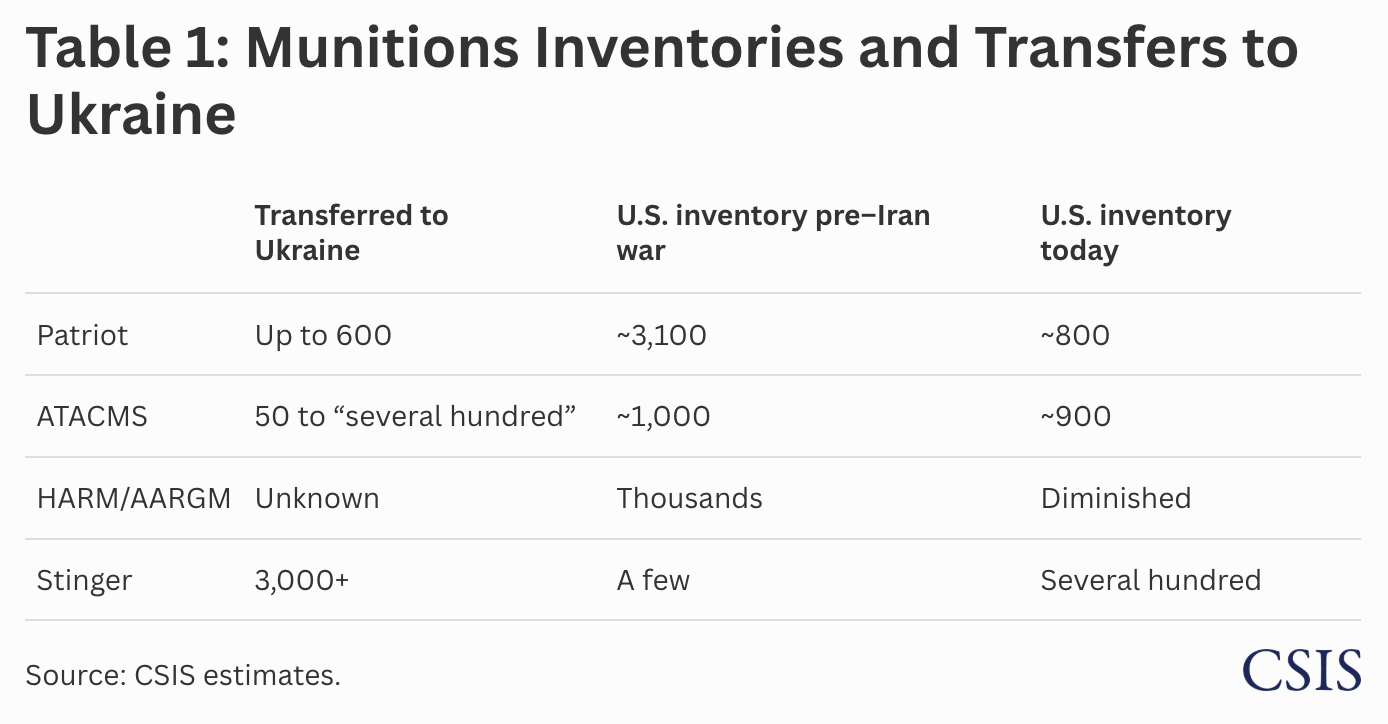
The United States has used about half of the initial inventory for three of these munitions (Patriot, THAAD, and PrSM) and about one-third of the initial inventory for the rest (JASSM, SM-2/3/6, and Tomahawk). Even so, enough remains for any plausible scenario in the war against Iran. The risk comes from potential future wars, particularly with China—but potentially also with Russia or North Korea.
Source: https://www.csis.org/analysis/six-reasons-why-united-states-low-munitions
It takes time to ramp up productions. In the same CSIS report, it estimated it could take 2-4 years for new missiles to be delivered:
The immediate problem is not money, but time. Current deliveries reflect funding before FY 2024, as it takes two to four years for munitions to be delivered once a contract is signed. With time, production will equal demand, but that is several years in the future. Until then, there is a window of vulnerability.
Washington can appropriate all the money it wants. Money does not compress a production timeline.
And that two to four year estimate carries an assumption buried inside it. It assumes the raw materials will be there when the factories are ready.
The absolute choke point: critical minerals
The Strait of Hormuz is the choke point between Asia and the Gulf. Critical minerals are the choke point for the missile supply chain.
BNN Bloomberg recently reported on how heavily defence systems lean on these inputs. A $150 million weapons system does not function if it's missing minerals worth $20,000 to $30,000.
Critical minerals play “an outsized role” in defense systems, Balladon said. A $150 million weapons system won’t work if it’s missing critical minerals that may be worth only $20,000 to $30,000, he said.
The defence sector is particularly reliant on the metal samarium and needs 50 to 100 tons each year, but U.S. capacity is very limited, he said.
For years, China has slowly builds out a near monopoly over critical minerals supply chains.
Since the 1990s, China has pursued a targeted policy to achieve dominance in relation to REEs and other critical minerals, implementing a national policy to prioritize selected minerals and technologies. China’s then-leader Deng Xiaoping is said to have remarked in 1992 during his trip to southern China to launch his economic reforms that, “the Middle East has oil; China has rare earth elements.”
Source: https://www.thearcticinstitute.org/dig-baby-dig-chinas-mineral-dominance-ripple-effects-arctic/
That was over 30 years ago. Three decades of patience positioning.
In addition to missiles, the New York Times has also reported on how samarium restrictions reach directly into fighter jet production:
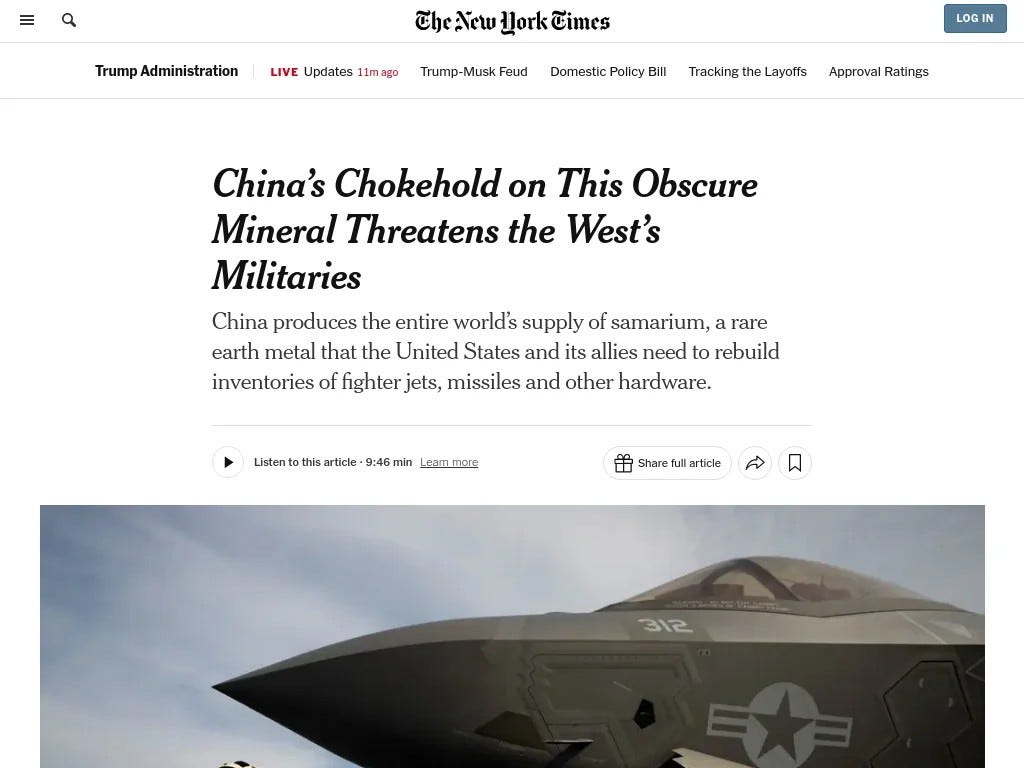
https://www.nytimes.com/2025/06/09/business/china-rare-earth-samarium-fighter-jets.html
Iran and Oman are near a deal
Over the past few weeks, instead of negotiating with the US, Iran has been focused on negotiating with Oman.
The narrow section of the Strait sits between Iranian and Omani waters. If those two governments agree to charge a “toll” on ships moving in and out, they can rewrite the economics of the waterway.
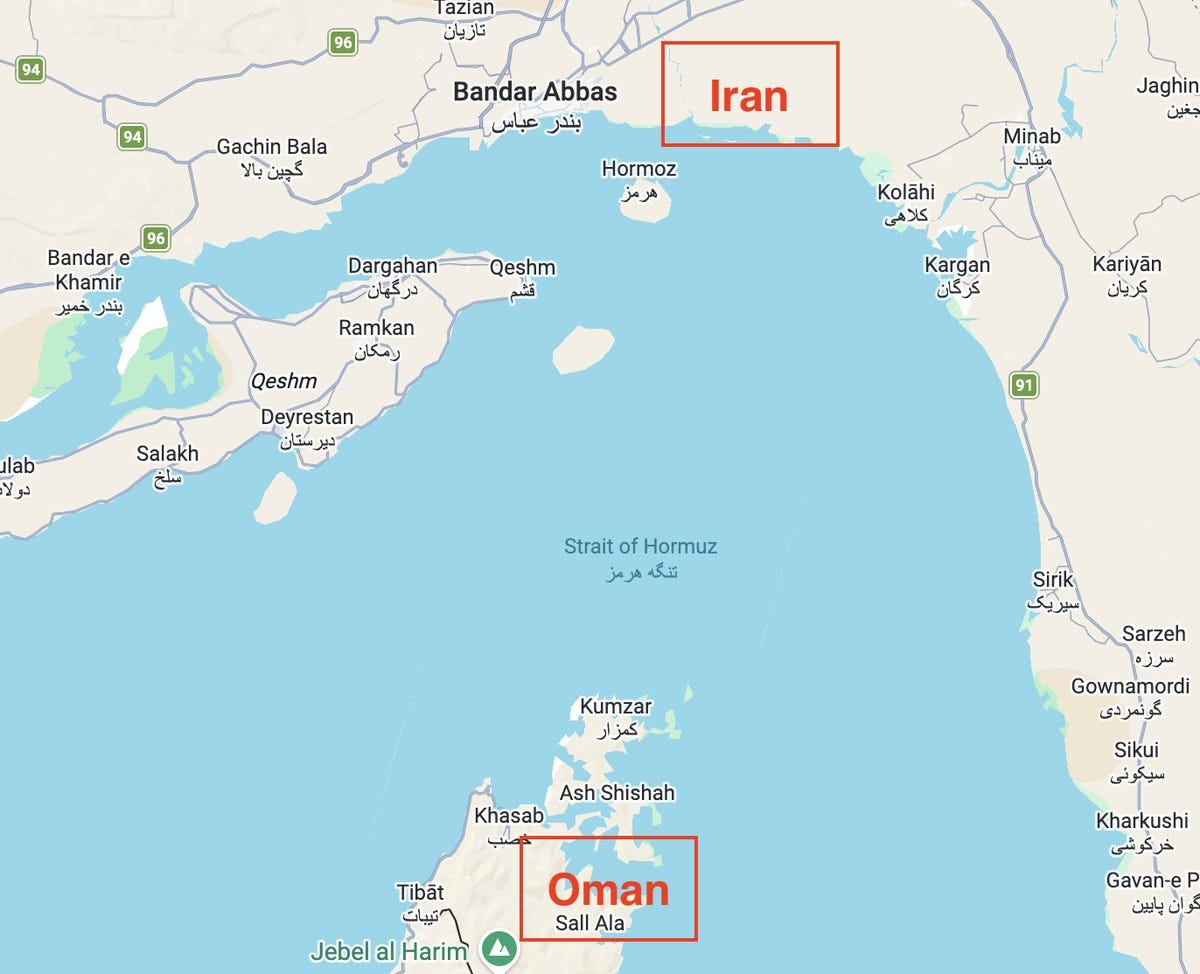
Image Credit: Google Map
According to the Associated Press, the emerging arrangement would have vessels enter the Persian Gulf through an Iranian-controlled route and exit through an Omani-controlled one, with service fees collected for providing security and preserving the maritime environment. Two regional officials described the terms.
In case you’re wondering, how can this happen, look up Strait of Malacca. A similar framework is being modelled for Hormuz.
The likely outcome
Iran and China are close. So I’ll say what I think is obvious: China is going to keep that valve tight on critical minerals heading to the US.
Which means even with domestic supply ramping up, the choke hold will take years to loosen.
And frankly I don’t think China cares whether Iran charges toll fee or not.
All they care is to keep getting Iran oil for cheap.
One path from here is a cold war style standoff, with the US Navy continuing to block Iranian vessels moving in and out of the Strait while nothing gets resolved.
But I don’t think that’ll last.
The midterm election is a few short months away. The Iran war is highly unpopular with the American public. Unless the Republican Party is prepared to lose badly, the US may have to “accept” a temporary resolution on the Iran-Oman deal, kick the can down the road, and leave it for the next President to deal with the aftermath.
Who knew that roughly one hundredth of one percent worth of minerals (20k critical minerals ÷ 150M weapons system) could decide whether the world’s most important waterway being imposed with toll fees?
If you like my work, I invite you to share it with others.
Eric Chang
Calgary, Alberta
August 4, 2026
Copyright © 2026 EC Research Group.
No part of this publication may be reproduced, distributed, or transmitted in any form or by any means, including photocopying, recording, or other electronic or mechanical methods, without the prior written permission of the publisher, except in the case of brief quotations embodied in critical reviews and certain other noncommercial uses permitted by copyright law.
The information provided herein is believed to be accurate and reliable, but EC Research Group does not guarantee its accuracy or completeness. The content is for informational purposes only and is not intended to be a substitute for professional financial advice. EC Research Group is not a financial advisor and does not provide personalized financial advice. The views and opinions expressed in this publication are those of the author and do not necessarily reflect the official policy or position of EC Research Group. The content may be subject to change without notice and may become outdated over time. EC Research Group is under no obligation to update or revise any information presented herein.
Investments involve risks, and individuals should consult with a qualified financial advisor before making any investment decisions. Prospective investors should carefully consider the investment objectives, risks, charges, and expenses of any investment before investing.