
Middle East is complicated, Alberta is not
Remember Operation Enduring Freedom?

Over the weekend, the United States and Israel went to war with Iran.
It did not take long before Iran’s Supreme Leader, Ali Khamenei, was killed in an airstrike.
Based on recent reports, the U.S. and Israel are close to achieving air superiority.
On the surface, it looks decisive.
It even feels like this conflict could end in a matter of weeks.
But if history has taught us anything, especially in the Middle East, it is this:
The opening chapter of a war often looks nothing like the ending.
Ryan Bohl, a geopolitical analyst, suggests the war may only be beginning.
And if he is right, this could turn into something far more prolonged than the headlines imply.
Removing Iran’s Supreme Leader won’t matter
The instinctive belief is simple:
Remove the head, and the body collapses.
That logic works in personalized regimes such as Saddam Hussein’s Iraq.
But Iran is structured differently.
The Islamic Republic operates through an ideological and institutional framework that is far more resilient than a single individual.
The Islamic Revolutionary Guard Corps (IRGC) has long operated with decentralized command authority. Local commanders are not waiting for instructions from the very top to retaliate. Their marching orders are embedded in doctrine.
In addition, there are no visible signs of mass military defections. No broad popular uprising. No structural fracture.
In other words:
Decapitation does not equal collapse.
This is not a personality driven regime.
It is an ideological machine.
And machines, once built, keep running.
Difference between achieving air superiority vs. ground operations
There is a massive gap between dominating the skies and winning a war.
Air superiority weakens infrastructure.
It destroys air defenses and it cripples logistics.
But it does not eliminate countless missile launchers hidden in mountains.
It also does not erase the drone networks.
Iran’s ballistic missile and drone programs are decentralized and dispersed.
Achieving control of the air does not automatically neutralize those threats.
To truly dismantle a hardened regime often requires boots on the ground.
Iran is not a small country.
It is a mountainous nation of roughly 90 million people, with difficult terrain and a population conditioned by decades of sanctions and confrontation.
A ground invasion would not be a short campaign.
It would mean climbing literal mountains.
Urban warfare in dense cities.
Supply lines stretched across hostile geography.
A movie we’ve seen before: Operation Enduring Freedom
After the attacks of September 11, 2001, the United States launched Operation Enduring Freedom.
The objective was clear:
Dismantle al Qaeda.
Remove the Taliban regime that sheltered them.
The Taliban government fell within weeks, major cities were under U.S. backed control.
The initial campaign was a Shock and Awe.
The United States military is extraordinarily effective at this type of war.
Rapid dominance, technological superiority, overwhelming force.
There is no debate about capability.
The U.S. possesses the most powerful military on Earth.
But power does not equal to victory.
Because winning depends on the rules of the game.
And in the Middle East, they play a very different game.
Playing the long game
What began in Afghanistan as counter terrorism slowly evolved into counter insurgency and nation building.
The mission shifted.
From eliminating Osama bin Laden, to rebuilding a centralized state in Kabul, to constructing a Western style democracy.
By the time the final U.S. aircraft departed Kabul in August 2021, the numbers told a sobering story:
Total Financial Cost: $2.3 Trillion including interest and veteran care.
U.S. Military Fatalities: 2,448.
Afghan Civilian Deaths: 46,000+.
Afghan Security Forces Deaths: 66,000+.
Duration: 19 years, 10 months.
Today, the Taliban is back in power, governing with the same fundamentalist ideology they held in the 1990s, by playing the long game.
We’re not clear on U.S. objectives
This is perhaps the most critical question right now.
What is the objective?
Is it eliminating Iran’s nuclear capability?
Is it regime change?
Is it strategic signaling toward Russia in Ukraine, or toward China regarding Taiwan?
Perhaps Trump is intentionally being unclear to give him strategic flexibility to navigate a rapidly evolving situation.
But flexibility can also blur accountability.
If the objective expands, the timeline will extend.
Alberta’s oil becomes more important
Whenever Middle Eastern conflict escalates, global energy market reacts.
Supply uncertainty pushes prices higher.
And when supply chains become fragile, proximity and reliability becomes more important.
Alberta sits on one of the largest proven oil reserves in the world.
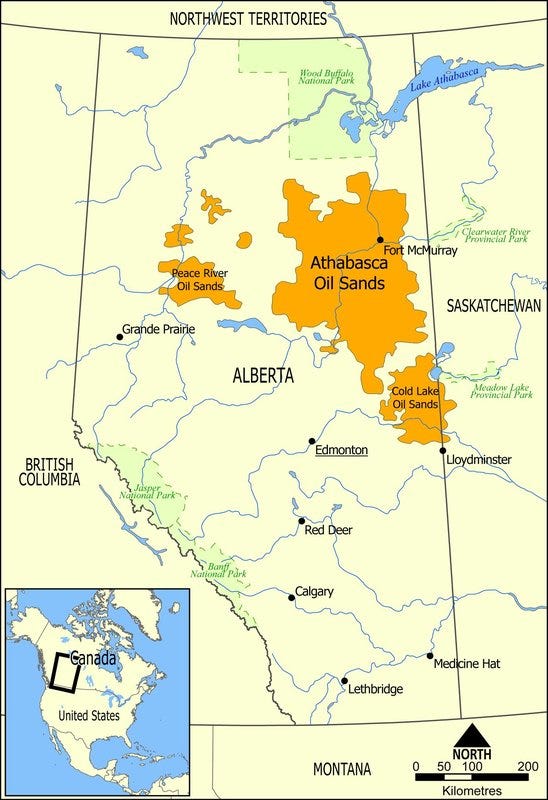
Image Credit: Wikipedia
In a prolonged conflict scenario:
Alberta becomes a stabilizing energy supplier
North American energy security becomes strategic leverage
Canada’s negotiating position in upcoming trade discussions strengthens
If this conflict drags on for months, or longer, Alberta may find itself in the driver’s seat because of stability.
If you like my work, I invite you to share it with others.
Eric Chang
Calgary, Alberta, Canada
March 3, 2026
Copyright © 2026 EC Research Group.
No part of this publication may be reproduced, distributed, or transmitted in any form or by any means, including photocopying, recording, or other electronic or mechanical methods, without the prior written permission of the publisher, except in the case of brief quotations embodied in critical reviews and certain other noncommercial uses permitted by copyright law.
The information provided herein is believed to be accurate and reliable, but EC Research Group does not guarantee its accuracy or completeness. The content is for informational purposes only and is not intended to be a substitute for professional financial advice. EC Research Group is not a financial advisor and does not provide personalized financial advice. The views and opinions expressed in this publication are those of the author and do not necessarily reflect the official policy or position of EC Research Group. The content may be subject to change without notice and may become outdated over time. EC Research Group is under no obligation to update or revise any information presented herein.
Investments involve risks, and individuals should consult with a qualified financial advisor before making any investment decisions. Prospective investors should carefully consider the investment objectives, risks, charges, and expenses of any investment before investing.