
The US’ biggest gift to China
An unintended consequence that China is welcoming with open arms

Between the tariffs and the Iran war, the inflation rate has been creeping up again this year.
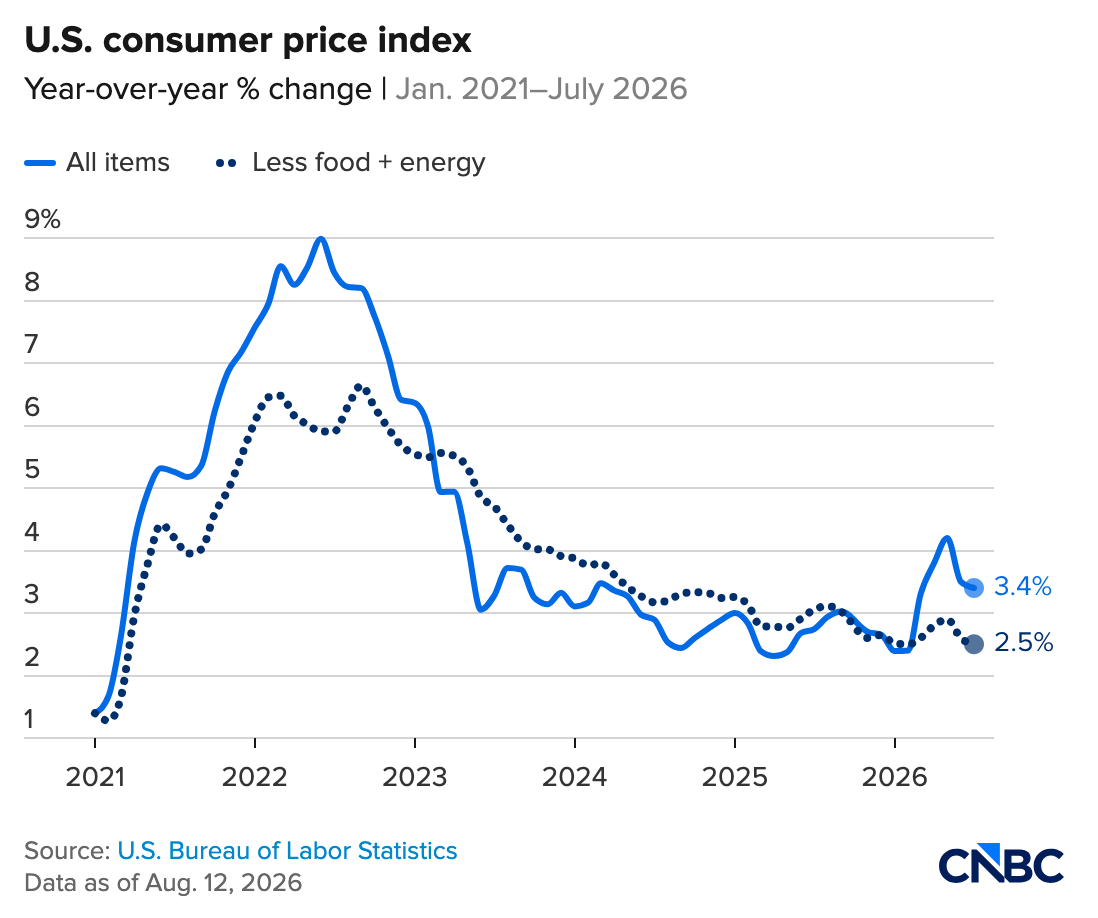
The shipping disruptions at the Strait of Hormuz is affecting everything we buy:
Oil affects the input cost for many products and services:
Plastics, asphalt, shipping, packaging, and every truck that moves goods from a warehouse to a shelf.
Airplane tickets become more expensive, that affects businesses, vacations, conferences, and every hotel and restaurant that depends on people showing up.
In addition, the Middle East supplies more than 60 million tons of fertilizers worldwide. An estimated 30% of the 60 million tons are shipped through the Strait of Hormuz alone.
Fertilizer prices are expected to stay high through 2028.
Expect food prices to increase in the coming months and years.
The intention of the US tariffs was to bring manufacturing jobs back to the US
While it is still an open debate on how well tariffs are working in bringing manufacturing back to the US, we have seen select industries making changes to their supply chain: Automotive, drug manufacturing, semiconductors.
But the consequences may only be a short term benefit to the US.
While some jobs are indeed coming back to the US, the damages inflicted from higher inflation are causing many US allies to look for solution from a place they would had turned their nose against in the past: China.
If you are a household in Germany, France, or Canada right now, and your grocery and living expenses is 20% higher than three years ago, while your mortgage is renewing at twice the rate, how long can you hold out?
How long before you start looking for cheaper alternatives?
How long before the political pressure on governments to lower the cost of living becomes overwhelming?
It is getting harder and harder to justify paying for higher prices when the easy way out may be importing cheaper Chinese goods.
Especially when the alternative is a family choosing between putting food on the table, cooling their houses in the summer or staying warm in winter.
China flooded the world with cheaper products
Let’s go back to the 1990s.
Western corporations were under pressure. Shareholders wanted higher margins. Labour costs in North America and Europe were rising.
Their answer was moving production to China.
At first, the logic was simple. China offered an enormous, disciplined workforce at a fraction of Western wages. Western executives got their margins. Consumers got lower prices. Everyone called it a win.
And for a long time, it was.
Over the past 30 years, global trade was quietly redesigned around one central assumption: China manufactures, the West consumes.
Entire industries relocated.
The “Made in China” label went from inferior, cheap products to everything is made in China.
Many industries have been destroyed by cheaper Chinese goods
But there was a cost.
The industrial casualties came in waves.
First, it was the industries Western economies quietly decided weren’t worth fighting for. Apparel and textiles. Footwear. Toys and plastic goods. Low margin, low value. The thinking was: “We’re moving up the value chain.”
Then came the industrial heartland. Steel. Raw materials. Shipbuilding. Entire port cities in Germany, the UK, and the US Great Lakes region hollowed out. Politicians called it “structural adjustment.” Workers called it something else entirely.
Then came product assembly. Consumer electronics. PCs and laptops. Everything moved East: The engineering talent. The supplier ecosystems. The institutional knowledge.
Then came solar. An industry the West (Europe) pushed and China scaled. China massively subsidized the entire industry. Today, China controls over 80% of global solar panel manufacturing. The clean energy revolution runs on Chinese supply chains.
And then came the brands.
Huawei. Oppo. BYD. These are not just cheap alternatives anymore. BYD is now the world’s largest EV company by production volume.
Not a Chinese knockoff of Tesla, a world leader in the EV.
Making cars better and cheaper than any of the EV companies in the West.
The world is addicted to cheaper Chinese-made products
The longer the rest of the world are paying for higher inflation, the more dependent these countries are on cheaper Chinese products.
The US may have the financial power to engage in a prolonged trade war with many countries around the world, the rest of the countries, many of them the “middle powers” are left with few options but to increase their imports from China to bring down inflation.
We are seeing that show up in China’s trade data.
While China’s trade balance has reduced with the the US, China has increase their exports to Europe and Asia.
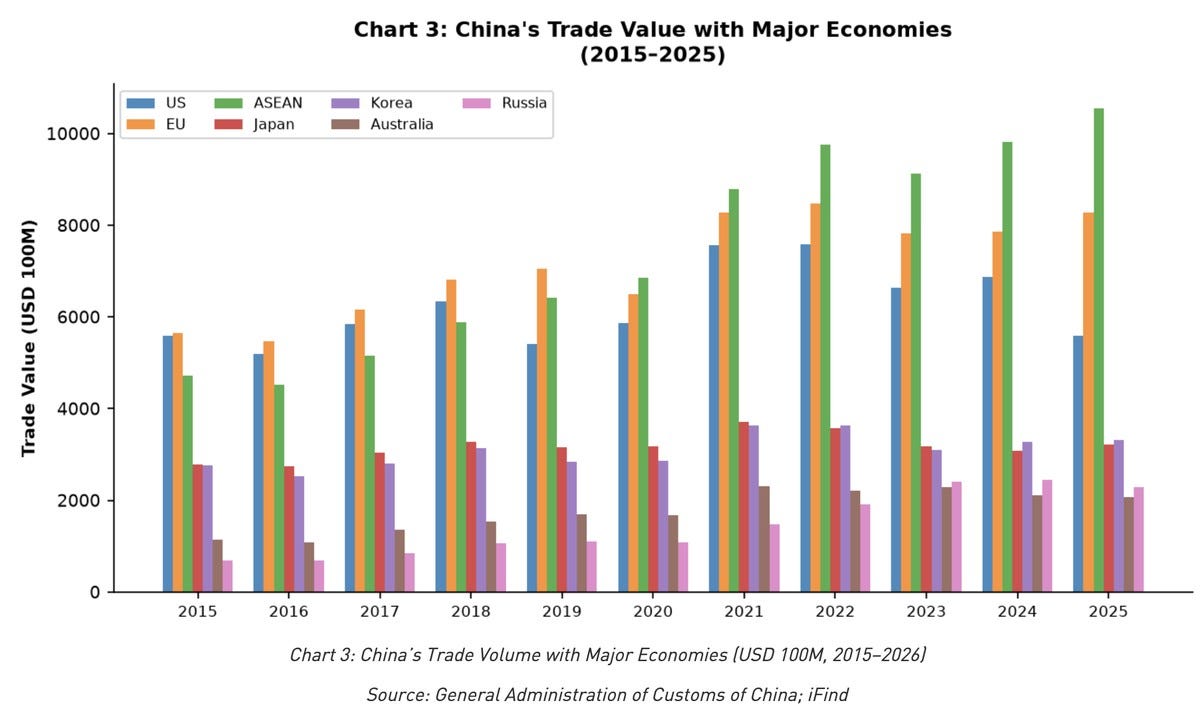
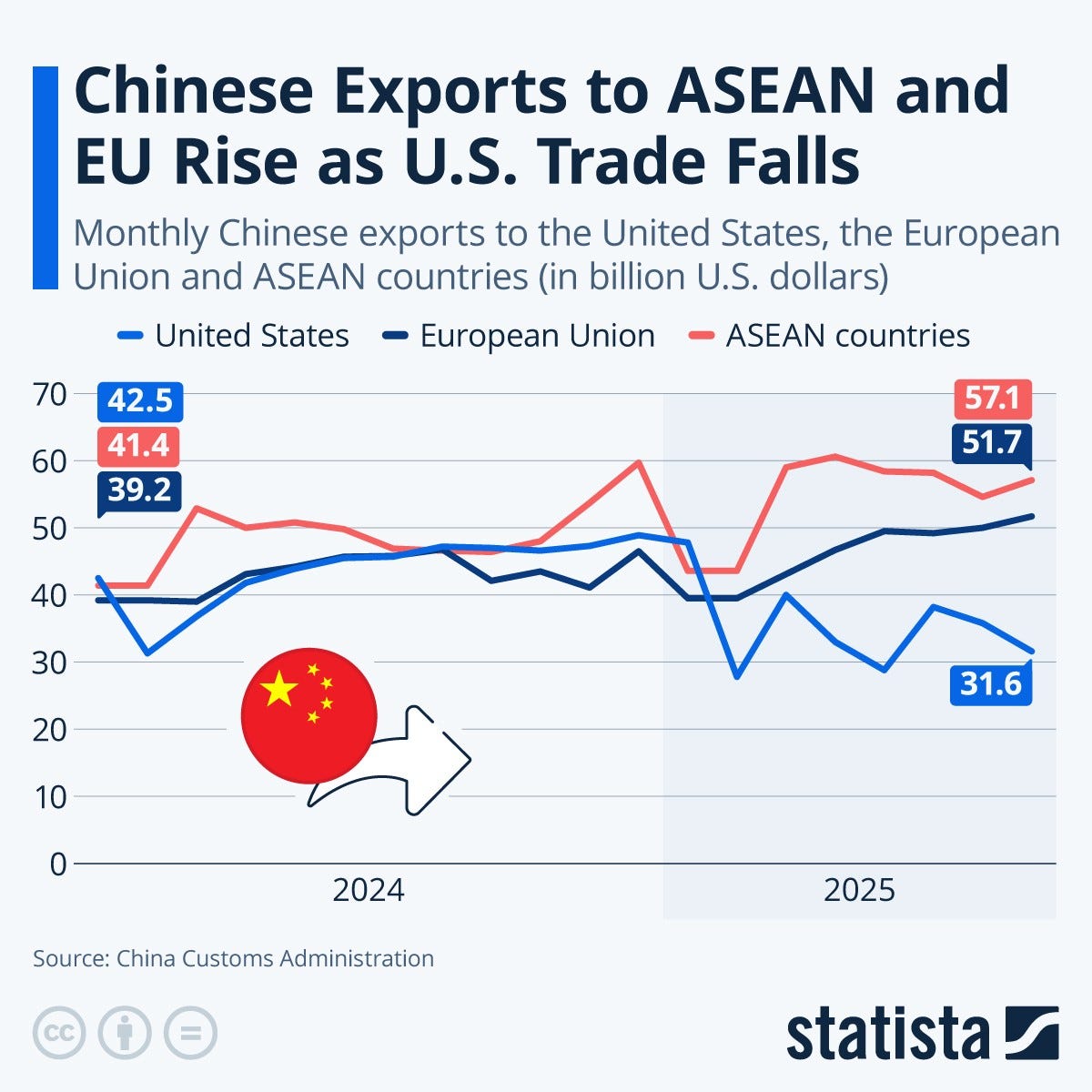
The US may have temporarily improved job prospects domestically, it slowly handed the power over the world to its biggest rival by making many countries even more dependent on China.
A higher inflationary environment may not slow Chinese imports.
It may further accelerate them.
And right now, for a lot of households in Europe and Canada, cheaper Chinese goods are starting to look less like a geopolitical risk, and more like relief.
If you like my work, I invite you to share it with others.
Eric Chang
Calgary, Alberta
August 18, 2026
Copyright © 2026 EC Research Group.
No part of this publication may be reproduced, distributed, or transmitted in any form or by any means, including photocopying, recording, or other electronic or mechanical methods, without the prior written permission of the publisher, except in the case of brief quotations embodied in critical reviews and certain other noncommercial uses permitted by copyright law.
The information provided herein is believed to be accurate and reliable, but EC Research Group does not guarantee its accuracy or completeness. The content is for informational purposes only and is not intended to be a substitute for professional financial advice. EC Research Group is not a financial advisor and does not provide personalized financial advice. The views and opinions expressed in this publication are those of the author and do not necessarily reflect the official policy or position of EC Research Group. The content may be subject to change without notice and may become outdated over time. EC Research Group is under no obligation to update or revise any information presented herein.
Investments involve risks, and individuals should consult with a qualified financial advisor before making any investment decisions. Prospective investors should carefully consider the investment objectives, risks, charges, and expenses of any investment before investing.