
When a Master speaks, I listen
Wise words from the first person to expose the accounting fraud at Enron before collapse

There is no shortage of opinions in financial media.
But there are few who put money where their mouth is.
Jim Chanos is one of the few.
He recently sat down for an interview that I think every investor with AI exposure should watch:
https://www.youtube.com/watch?v=oM7VevsftrY
I want to highlight 3 quotes from the video (there were loads of nuggets in the interview, I highly recommend watching the entire video).
Before I get to those, it’s worth understanding why I pay attention when he speaks.
An impressive career
Chanos has spent four decades doing the unglamorous work of sifting through financial statements, reading footnotes while others chasing the headlines.
His track record:
Baldwin-United (1982). As a young analyst, he flagged the insurance and annuity company as insolvent while Wall Street stayed bullish. It filed for bankruptcy in 1983, one of the largest failures of its era.
Boston Chicken / Boston Market (late 1990s). He called out the franchise-financing accounting. The company went bankrupt by 1998.
Enron (2000 to 2001). His most famous call. He began shorting in late 2000 after noticing declining return on capital, opaque related-party transactions, and aggressive mark-to-market accounting. Enron collapsed into bankruptcy in December 2001.
Tyco International (2002). Shorted on accounting concerns. The stock cratered as CEO Dennis Kozlowski’s fraud unravelled.
Homebuilders and subprime names (2007 to 2008). He positioned bearishly before the financial crisis arrived.
In most cases, the consensus was comfortable. The analysts were positive. The stocks looked bullish.
Yet he has uncovered situations after situations by looking at numbers.
The accounting at these companies were telling different stories than the popular narratives at the time.
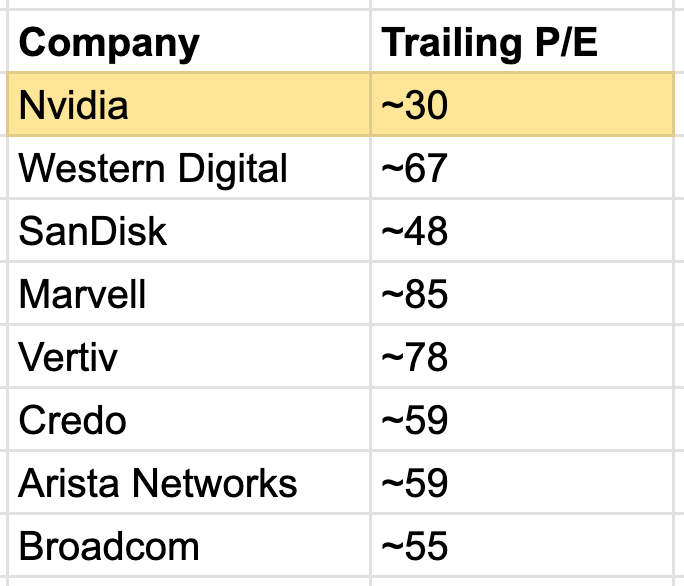
“No one that is dependent upon Nvidia to exist should trade at a higher valuation than Nvidia itself”
On valuation in the AI supply chain, Chanos made the point that nobody who depends on Nvidia to exist “should trade at a higher valuation than Nvidia itself.”
When a Master speaks, there’s a simplicity to the message.
His point was simple:
If Nvidia chips are the most essential technology powering the AI revolution, then it doesn’t make sense for companies in the AI supply chain to be more valuable than Nvidia, based on valuation multiples.
Nvidia is the gatekeeper of this entire boom. It owns the scarce resource. Everyone else’s business is an extension of Nvidia.
It doesn’t make a lot of logical sense for a company in the supply chain to be trading at a higher valuation than the gatekeeper.
If your revenue depends entirely on securing someone else’s chips, you don’t control your margins nor do you control your timeline.
Yet, that’s exactly what’s happening with many stocks today.
Here are some examples:
“People are making decisions on long-term projects based on spot prices and that’s a terrifying thing”
I love this quote.
Because this is exactly the same problem that got many Vancouver and Toronto real estate investors in trouble over the past few years.
We wrote about the condo bust in Vancouver and Toronto.
Many of those projects were penciled when the interest rate was at record low, around 2%, while rent was at record high.
Spot prices represent the market today.
Long term sustainability of a project has little to do with spot price or the market condition today.
Any seasoned real estate investors will tell you, they underwrite their deals based on several stress tests: Interest rate sensitivity, cap rate softening, higher vacancies, etc.
A data centre is a 10-20 year physical asset. It requires enormous long-term debt to build.
Right now there is a shortage of advanced GPUs, so short-term rental rates for compute are very high.
Data center developers are running their pro formas on those numbers and telling investors great returns ahead.
They are underwriting a twenty year liability using a price that exists only because supply hasn’t caught up yet.
Technology cycles are short. Capacity is being built at record pace. Models are getting more efficient every quarter, which means the same output requires less compute.
When those spot rates normalize, the revenue falls. The debt does not.
Sounds familiar?
It’s the Vancouver and Toronto condo bust story all over again.
“We’re in the period now where everything is being valued as if it has worked or it will work, and that was the problem with ‘99-2000”
This is the definition of a market with zero margin for error.
Current valuations across many AI-related companies don’t price in a base case. They price in the blue-sky case, achieved on schedule, with full monetization, with no competitive erosion.
When a whole ecosystem is priced on the assumption that nothing goes wrong, the repricing doesn’t require a catastrophe.
It only requires a change of psychology.
That’s exactly what happened in 2000.
Investors weren’t wrong that the internet would change everything. They were wrong about timing and valuation.
Few investors today remember the dotcom bubble.
I was too young to invest in the market back then.
What I do remember, is the story my uncle told me:
“Eric, I thought I was going to retire with my stock portfolio. I had to stay working after the dotcom bubble popped.”
It took about 15 years to recover from the dot-com peak. From March 10, 2000 to April 23, 2015 (not adjusting for inflation).
If my memory is correct, my uncle worked an extra 20 years after the bubble popped.
He probably have forgotten telling me his story from years ago, after all, 20 years is a long time.
But it’s something I will never forget.
If you like my work, I invite you to share it with others.
Eric Chang
Calgary, Alberta
July 28, 2026
Copyright © 2026 EC Research Group.
No part of this publication may be reproduced, distributed, or transmitted in any form or by any means, including photocopying, recording, or other electronic or mechanical methods, without the prior written permission of the publisher, except in the case of brief quotations embodied in critical reviews and certain other noncommercial uses permitted by copyright law.
The information provided herein is believed to be accurate and reliable, but EC Research Group does not guarantee its accuracy or completeness. The content is for informational purposes only and is not intended to be a substitute for professional financial advice. EC Research Group is not a financial advisor and does not provide personalized financial advice. The views and opinions expressed in this publication are those of the author and do not necessarily reflect the official policy or position of EC Research Group. The content may be subject to change without notice and may become outdated over time. EC Research Group is under no obligation to update or revise any information presented herein.
Investments involve risks, and individuals should consult with a qualified financial advisor before making any investment decisions. Prospective investors should carefully consider the investment objectives, risks, charges, and expenses of any investment before investing.