
2.6 Trillion Dollar bet on the market
Sell in May and go away?

We’ve just witnessed one of the fastest market reversals in history.
The S&P 500 went from being down roughly 10% to recovering all its losses and then reaching an all-time high. In a matter of weeks.
I study markets through the lens of a risk manager. It’s how I approach most things: Real estate development and asset management, entrepreneurship, etc.
That means I focus on asymmetrical opportunities, the ones where the reward significantly outweighs the risk. It also means I don’t act on every single opportunity that shows up.
I only move when the risk-adjusted reward is genuinely favorable.
Right now, that calculation has flipped. What I’m seeing today isn’t opportunity. It’s gambling.
Michael Burry says the market today feels like "the last months of the 1999-2000 bubble"
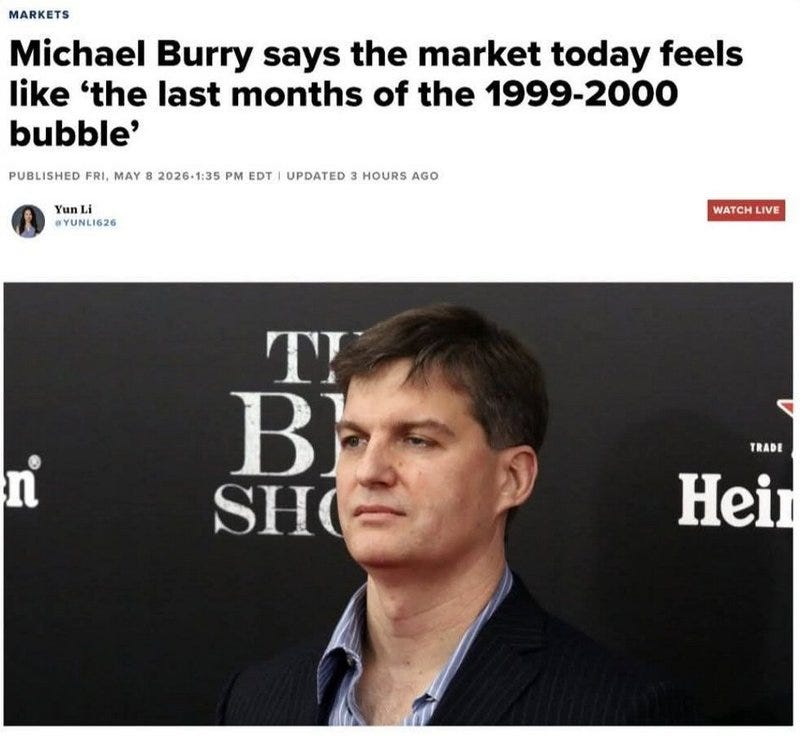
Image Credit: CNBC
Michael Burry is the eccentric hedge fund manager who diagnosed the rot inside the US housing market years before anyone else did. He made a legendary bet against mortgage-backed securities and walked away with hundreds of millions while Wall Street burned.
If you haven’t seen The Big Short, watch it. If you’ve already seen it, watch it again. The film does an excellent job translating a deeply complex financial collapse into something every investor can understand.
I revisit it every few years. Not for entertainment, but as a reminder of what happens when reckless leverage gets unwound.
Watch it again, then tell me what you think of some of the behaviors showing up in the market today.
CNN's Fear and Greed Index did a complete 180
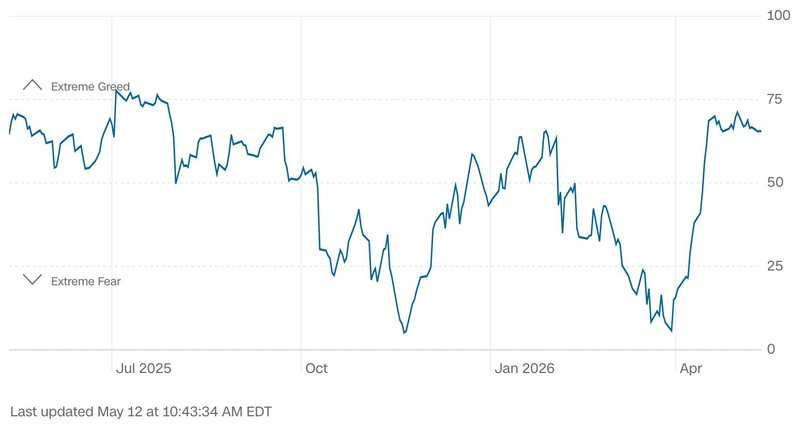
Image Credit: CNN
At the end of March, the index was sitting at “extreme fear.”
Today, we’ve crossed into “greed.”
We haven’t hit “extreme greed” yet on the index itself. But if you look at the options market, extreme greed is already there.
On May 9, SPX call options reached a record of $2.6 trillion in underlying value
Let me explain what that means.
A stock option is an instrument that lets a speculator bet on the direction of a security without owning it outright.
A “call option” gives the buyer the right to purchase the underlying security at a set price. But not the obligation, and not the actual ownership.
The result is a leveraged bet on where the underlying security is going, at a fraction of the cost of buying the real thing.
On May 9, call options on the S&P 500 index reached an all-time record, representing $2.6 trillion in underlying value. All in a single day.
It’s a record we have NEVER seen before.
Naturally that caught my attention. But what made me stay alert is the parabolic move in the options market.
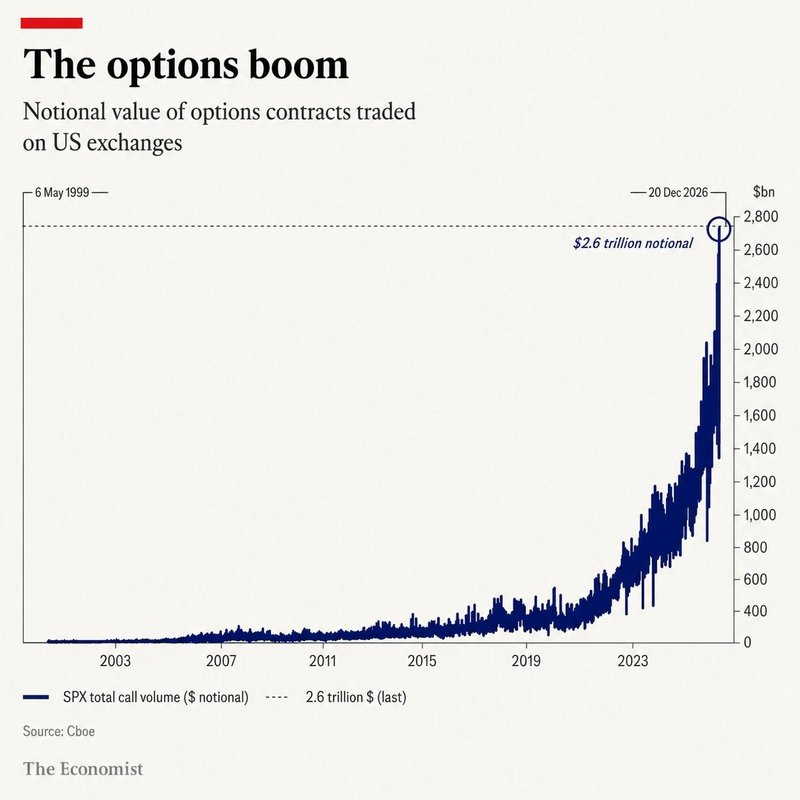
Image Credit: The Economist
Look at the chart. Ask yourself a simple question: does this look like a healthy market recovery? Or does it look like a massive bet in the market right now?
There is an old saying on Wall Street: Sell in May and go away
The idea is simple. Summer markets tend to underperform. Traders go on vacation. Trading volumes are lower. The momentum that drives markets in the spring often fades.
Will that happen this year? No one knows for certain. We may see a selloff in the coming weeks, or we may not. Markets can stay irrational longer than most people expect.
But here is what I can say with confidence: the more speculative a market becomes, the more painful the eventual correction.
The party at the nightclub is still going. The music is loud and the drinks are flowing.
Few ever thinks about the morning while they’re still on the dance floor.
Go watch The Big Short, and let me know what you think!
If you like my work, I invite you to share it with others.
Eric Chang
Seoul, South Korea
May 12, 2026
Copyright © 2026 EC Research Group.
No part of this publication may be reproduced, distributed, or transmitted in any form or by any means, including photocopying, recording, or other electronic or mechanical methods, without the prior written permission of the publisher, except in the case of brief quotations embodied in critical reviews and certain other noncommercial uses permitted by copyright law.
The information provided herein is believed to be accurate and reliable, but EC Research Group does not guarantee its accuracy or completeness. The content is for informational purposes only and is not intended to be a substitute for professional financial advice. EC Research Group is not a financial advisor and does not provide personalized financial advice. The views and opinions expressed in this publication are those of the author and do not necessarily reflect the official policy or position of EC Research Group. The content may be subject to change without notice and may become outdated over time. EC Research Group is under no obligation to update or revise any information presented herein.
Investments involve risks, and individuals should consult with a qualified financial advisor before making any investment decisions. Prospective investors should carefully consider the investment objectives, risks, charges, and expenses of any investment before investing.