
IPO dream to get rich quick
A pipe dream that is

The IPO machine works exactly as designed.
Sell the hype and the dream.
Wall Street is great at doing that.
We wrote about the buzz surrounding IPOs and how the entire mechanism is designed to help the insiders to get rich:
https://www.ecresearchgroup.com/p/ipos-are-for-the-insiders-to-get
The founders. The venture funds. The early employees who bought their shares years ago for pennies.
By the time a company rings the opening bell, the real gains have already been captured. Privately. Long before you ever saw a ticker symbol.
An IPO is not the start of the party.
It’s the exit door.
The SpaceX IPO dream
We also wrote the reason I stayed far away from the feeding frenzy here:
https://www.ecresearchgroup.com/p/great-article-are-you-buying-any
Since then, SpaceX stock has rocketed to the moon and back. It went from an IPO price at $135 / share, skyrocketed to over $200 and now it’s down to around $120, below the IPO price.
It took SpaceX’s stock 3 days to reach the moon, an all time high.
That is about the same amount of time it takes for a spacecraft to travel from Earth to the Moon.
Coincidence?
The universe works in mysterious ways.
Next on the launch pad: The AI labs
Markets have short memories.
In a few months, Wall Street will roll out the next shiny object: Anthropic IPO.
Anthropic, the company behind the Claude chatbot, is reportedly eyeing an October listing:
https://www.cnbc.com/2026/07/15/anthropic-ipo-banks-investor-meetings.html
Last week, we discussed an alternative way to participate in the AI boom, with an asymmetrical returns vs. the risks taken:
https://www.ecresearchgroup.com/p/the-ai-race-everyone-sprinting-for
This week, let’s look at what we consider as the opposite: a higher potential risk to lower potential reward.
In other words, an opposite of asymmetrical return: an asymmetrical risk.
First up: an exciting future
Less than 4 years ago, on November 30, 2022, OpenAI debuted ChatGPT.
Since then, you couldn’t sit at a coffee shop and finish a cup of coffee without hearing people talk about AI this or AI that.
After November 30, 2022, on the surface, the world seems very much the same.
Yet, within businesses large or small, at comedy shows, church talks, and wedding vowels, AI has seeped into many aspects of our lives.
As AI adoption becomes widespread, the future will be a very interesting place to be.
AI will be able to help humans accomplish tasks we don’t find enjoyable to do.
It could unlock human creativity few can fathom today.
Innovation is about to exponentially expand.
Diseases that were once untreatable due to cost constraints, AI is now developing new drugs faster and cheaper, giving hope to many people.
Endless entrepreneurial ventures will be launched, offering better solutions for many problems we have today.
The big risks to AI labs?
With the great opportunities ahead, what are the risks lurking on the horizon?
The particular risks I’m following have to do with the AI labs business model.
This is a big one:
Open source AI vs. commercial AI.
Since software came into our modern lives, there have been 2 types of software that are available: open source vs. closed source or proprietary software.
For example, you know Windows, the most popular operating system for PCs today.
It’s made by Microsoft, and they profit by selling millions of licenses to PC manufacturers.
What you may or may not know is there’s a whole world of open source operating systems, with the most famous one called Linux.
There are also variations of Linux, designed for specific needs or preferences. These variations are called forks, because they are “forked” from the original Linux programming codes.
This is the same thing with Microsoft Office (Word, Excel, PowerPoint), a commercial software, or there’s software such as OpenOffice or LibreOffice, which are completely free to download at anytime.
Microsoft won the PC operating system game while AI battle is far from over
Not counting computer servers, or Apple’s Macs, Microsoft is essentially a monopoly in the PC operating system market.
With AI, the battle between commercial and open source is far from over.
That’s because the costs to use these AI models are expensive.
Companies such as Uber have used up their entire year’s AI budget halfway through the year.
While AI has proven effective in some tasks, it can be expensive to use AI for simple, basic tasks that humans excel at.
Companies are now increasingly turning to cheaper solutions: the open source AI models to replace some tasks performed by commercial AI labs: Anthropic, OpenAI, Google, etc.
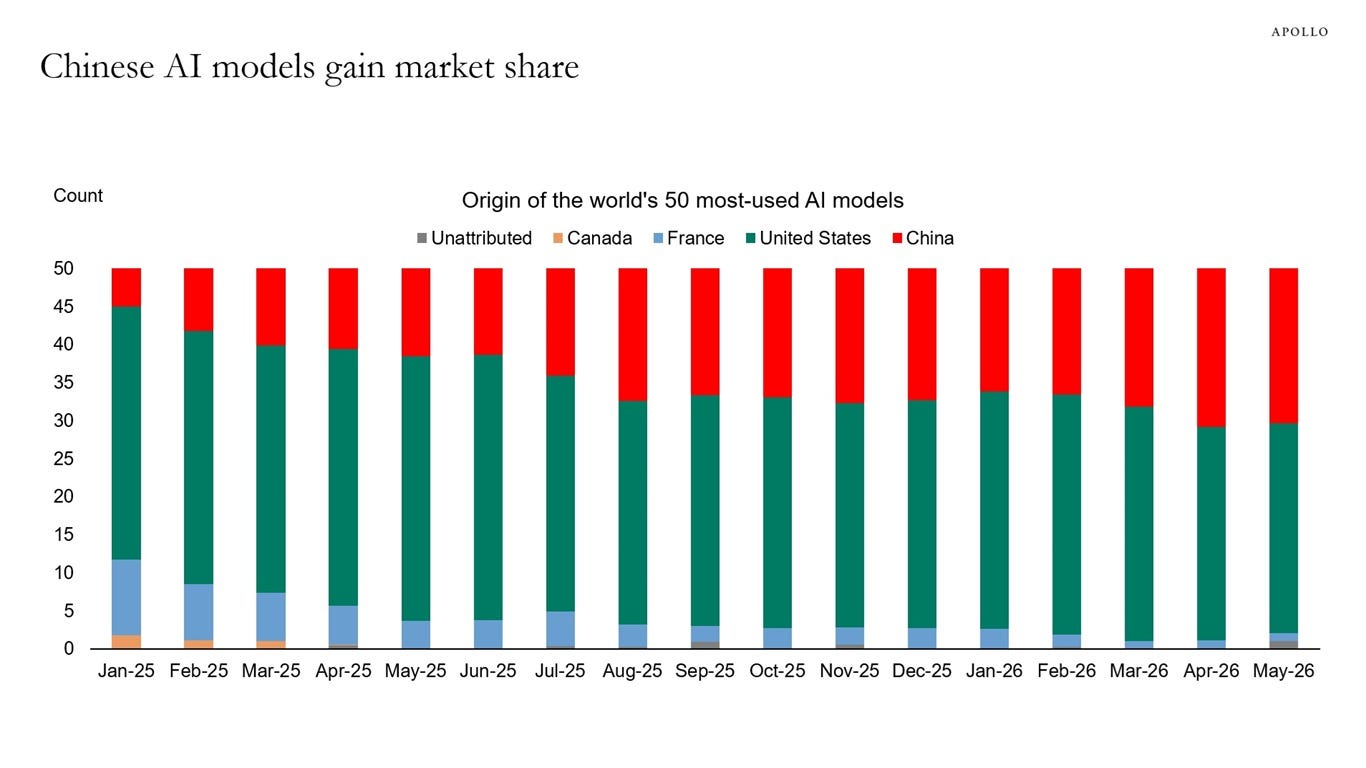
Many of these aren’t small companies. Reported in the Financial Times: Major companies like DoorDash, Airbnb, and Siemens are adopting Chinese AI tools.
According to data from OpenRouter, a platform that provides all-in-one access to major AI models and tracks their usage, leading Chinese models from DeepSeek and Z.ai have overtaken US equivalents like Anthropic’s Claude and OpenAI’s ChatGPT.
Source: https://finance.yahoo.com/technology/ai/articles/us-companies-realizing-chinese-ai-200146747.html
Buying IPOs are about future earnings
Most popular IPOs are about their growth trajectory.
If a company can grow faster than the high valuation placed during the IPO, the stock can be attractive.
The problem with these AI labs?
Open-source AI models consistently undercut them in price.
Not to mention, because of their open-source nature, many of these AI models can be “forked” into countless specialized AI models designed for specific purposes.
Open source is not inferior, it’s only behind by 4 months
One reason why Microsoft has a commanding lead on Windows and Office is that their open source competitors: Linux, OpenOffice or LibreOffice is not as well designed for everyday user.
By creature of habit, most people will not switch to open-source software to save a few bucks if it is less convenient to use.
Compare this to AI models: open-source AI models aren’t “inferior”. They may be “inferior” if we compare their performance today against the top commercial models (referred to as the frontier models).
But the difference is simply time.
If we compare many of today's open-source models to the frontier models from a few months ago, they are neck and neck.
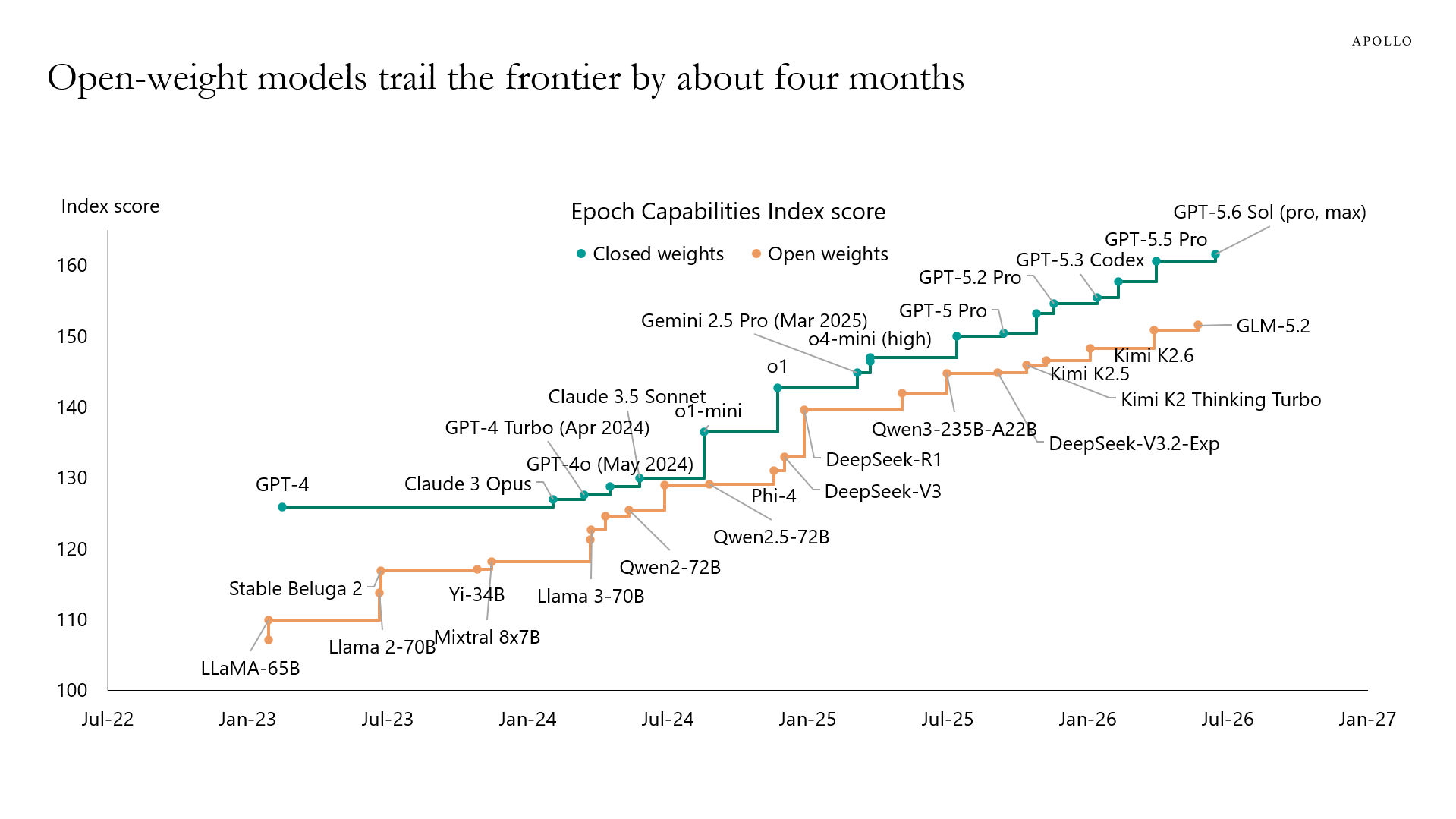
This is the key difference: open-source software didn’t threaten Microsoft, but the open source AI models pose the biggest risk to AI labs.
Would you buy a stock when their competitive advantage is only 4 months?
Warren Buffett refers to this as the “economic goodwill”.
The “economic goodwill” isn’t something that shows up on the balance sheet.
Economic goodwill is the true, intrinsic value of a company’s invisible assets, like brand reputation, customer loyalty, and intellectual property.
These could also be referred to as the company’s “moat”.
For example, Apple’s economic goodwill is enormous. Their biggest asset is their brand. Not to mention their distribution network, supply chain network, etc.
Their brand and their network make it extremely difficult for another competitor to compete.
That’s what makes a company such as Apple a great long term investment.
With these AI labs, their biggest asset - their frontier models are only competitive for 4 months.
Yes, 4 months.
I rest my case
To be clear, I think these AI labs are going to fundamentally change the lives as we know it.
I also think they could be around for years to come.
I’m simply evaluating these companies through a lens of risk versus reward.
The trillion dollar question I have for you to consider:
How much are you willing to pay for a company when their IP is only competitive for 4 months?
P.s. I said trillion because based on current valuations, Anthropic and OpenAI are valued around a trillion dollars each.
If you like my work, I invite you to share it with others.
Eric Chang
Calgary, Alberta
July 21, 2026
Copyright © 2026 EC Research Group.
No part of this publication may be reproduced, distributed, or transmitted in any form or by any means, including photocopying, recording, or other electronic or mechanical methods, without the prior written permission of the publisher, except in the case of brief quotations embodied in critical reviews and certain other noncommercial uses permitted by copyright law.
The information provided herein is believed to be accurate and reliable, but EC Research Group does not guarantee its accuracy or completeness. The content is for informational purposes only and is not intended to be a substitute for professional financial advice. EC Research Group is not a financial advisor and does not provide personalized financial advice. The views and opinions expressed in this publication are those of the author and do not necessarily reflect the official policy or position of EC Research Group. The content may be subject to change without notice and may become outdated over time. EC Research Group is under no obligation to update or revise any information presented herein.
Investments involve risks, and individuals should consult with a qualified financial advisor before making any investment decisions. Prospective investors should carefully consider the investment objectives, risks, charges, and expenses of any investment before investing.