
Middle East is only 1 front of the war
Keep an eye on the other battlefield

A war is much more complex than what people see on the news.
Most media coverage tends to focus on the physical war. The missiles. The strikes. The body count.
A war is fought on multiple fronts.
Physical war is only 1 front.
The US may seem to be winning part of the physical war. Their military capability is not in question.
As for the other battlefields, the winners have yet to be decided.
Iran’s stubborn proposal to end the war
If you have been tracking the US negotiations on ending the Iran war, you may know by now that Iran hasn’t given in on their terms.
It is the US that has consistently shown flexibility: negotiating, extending deadlines, signalling willingness to compromise.
Iran has not promised to end their nuclear program. They have not agreed to turn over the enriched uranium as demanded by the US.
Iran’s foreign ministry spokesman has recently said:
“Iran's nuclear enrichment rights cannot be negotiated.”
Instead, Iran has leveraged the war to demand compensation for war damage. And now, they are claiming full control over the Strait of Hormuz.
Prior to the war, Iran only threatened to shut down the Strait. Now they are claiming ownership of it.
They have escalated their position, not weaken it after the US and Israel carried out significant bombings against them.
Iran is playing the long game. They are extending the timeline of this war deliberately, while opening up a new front entirely.
We wrote about Iran’s long game during the early part of the war.
You can read it here:
https://www.ecresearchgroup.com/p/middle-east-is-complicated
War on debt
The war in Iran is pushing some foreign governments to sell off US Treasuries.
Part of the reason is necessity: foreign governments sell US Treasuries to buy their own currencies back, reducing supply and defending exchange rates. Japan is a clear example.
I was visiting Japan a few weeks ago. The yen had depreciated since the war started. Everything felt a little cheaper as a result.
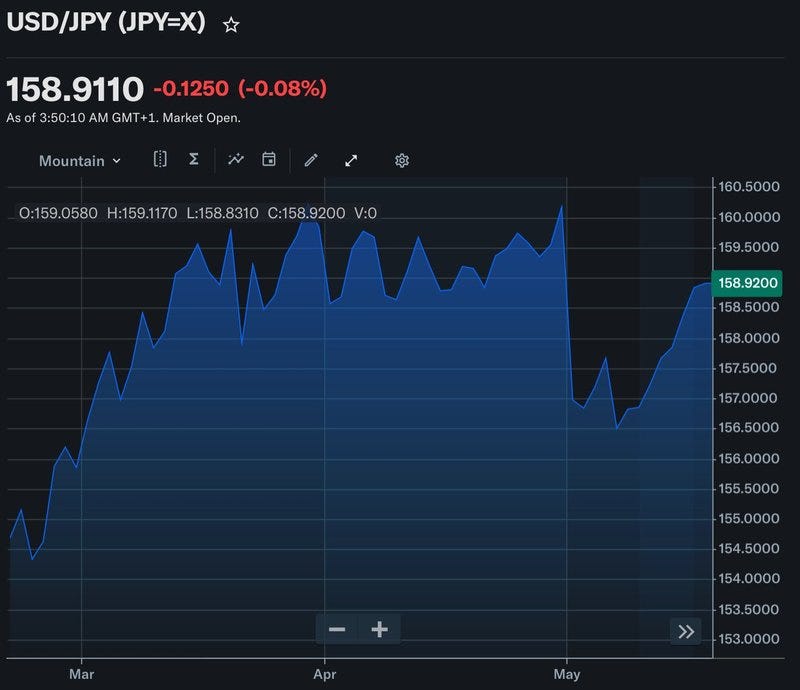
Source: Yahoo Finance
China has also been reducing their US Treasury holdings, dropping to the lowest level since 2008.
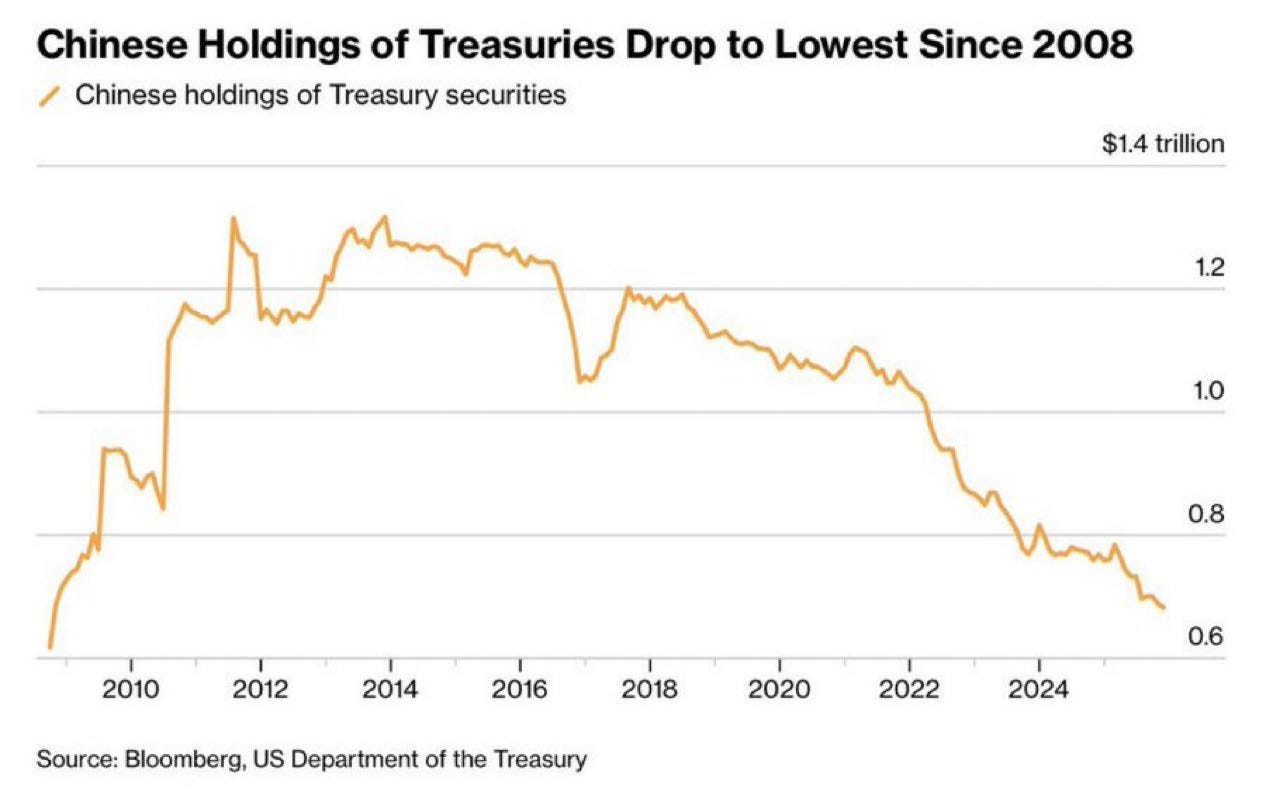
This is the other battlefield Iran is betting on.
Iran may not win a military confrontation directly against the US. The US has the strongest military in the world.
But Iran does not need to win militarily. Their advantage is time. And using the US debt load against the US.
As higher oil prices push inflation up, and as foreign governments reduce their US Treasury purchases or even selling off some of their US Treasury holdings, the supply of US Treasury increases on the open market. That pushes interest rates higher on US debt.
The war is being fought on the US debt, not just on the ground.
“30-year Treasury yield tops 5.19%, highest since before the financial crisis”
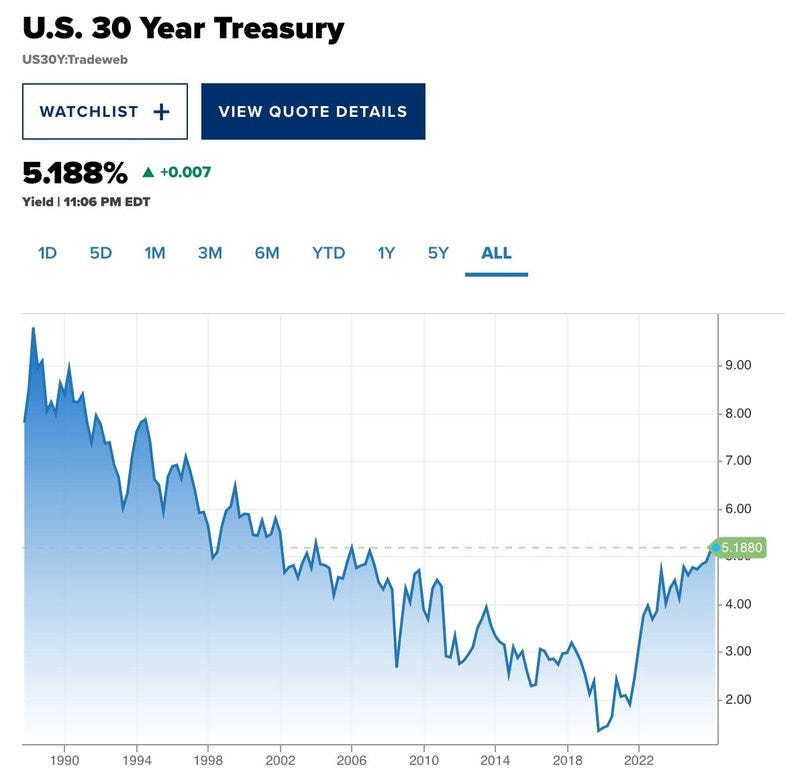
Source: https://www.cnbc.com/2026/05/19/treasurys-yields-inflation-traders-fed-interest-rates.html
That was the headline on a CNBC article published today.
When the bond rate moves higher, it doesn’t stay contained to Wall Street. Mortgage rates, auto loans, and corporate debt are all connected to the Treasury rate.
The war is about to get more expensive.
Not to Iran. The damage to many of their military assets is largely done.
But to the rest of the world.
Because US Treasuries are considered one of the safest investments on earth, rising yields there act as a floor that pulls every other rate higher. Government bonds. Corporate bonds. Borrowing costs everywhere.
The ripple goes global.
Printing money to buy US Treasuries
Here is what could come next.
We may see the Fed and the US Treasury start printing money to buy their own debt, in an attempt to push interest rates back down.
They won’t call it money printing, of course. They never do.
Last time, they called it “Quantitative Easing.”
This time, expect a new term. A new label for the same mechanism.
The problem with that solution is a familiar one: money printing leads to higher inflation down the road. The only scenario where it does not is a recession, where the overall economic demand collapses fast enough to offset the new supply of money.
So the question becomes: higher inflation, or recession?
Either outcome is a difficult environment for anyone near or in retirement who relies on income from investment such as bonds.
Many investors are watching the news on the Middle East.
But the more consequential battle may be the one happening quietly in the bond market.
Which front of the war are you watching?
If you like my work, I invite you to share it with others.
Eric Chang
Chicago, Illinois, USA
May 19, 2026
Copyright © 2026 EC Research Group.
No part of this publication may be reproduced, distributed, or transmitted in any form or by any means, including photocopying, recording, or other electronic or mechanical methods, without the prior written permission of the publisher, except in the case of brief quotations embodied in critical reviews and certain other noncommercial uses permitted by copyright law.
The information provided herein is believed to be accurate and reliable, but EC Research Group does not guarantee its accuracy or completeness. The content is for informational purposes only and is not intended to be a substitute for professional financial advice. EC Research Group is not a financial advisor and does not provide personalized financial advice. The views and opinions expressed in this publication are those of the author and do not necessarily reflect the official policy or position of EC Research Group. The content may be subject to change without notice and may become outdated over time. EC Research Group is under no obligation to update or revise any information presented herein.
Investments involve risks, and individuals should consult with a qualified financial advisor before making any investment decisions. Prospective investors should carefully consider the investment objectives, risks, charges, and expenses of any investment before investing.