
We're now in a standoff
The disconnection between risk and reward

For weeks, the media kept telling you the Strait of Hormuz was closed.
It wasn’t.
Historically, Iran has threatened to close the Strait during diplomatic tensions, conducting military exercises to demonstrate their ability to mine or block the narrow passage. That’s the playbook they’ve used in the past. Rattle the cage. Make headlines. Watch oil prices flinch.
But the reality this time was different.
Iran turned the Strait into a toll booth, charging select countries a reported $2 million per tanker to pass through. It was a shakedown, not a blockade. A “perceived closure” while the Strait technically stayed open-ish:
https://www.axios.com/2026/04/09/iran-us-strait-of-hormuz-khamenei
Now it’s the US’s turn. The US Navy is currently blockading the Strait of Hormuz.
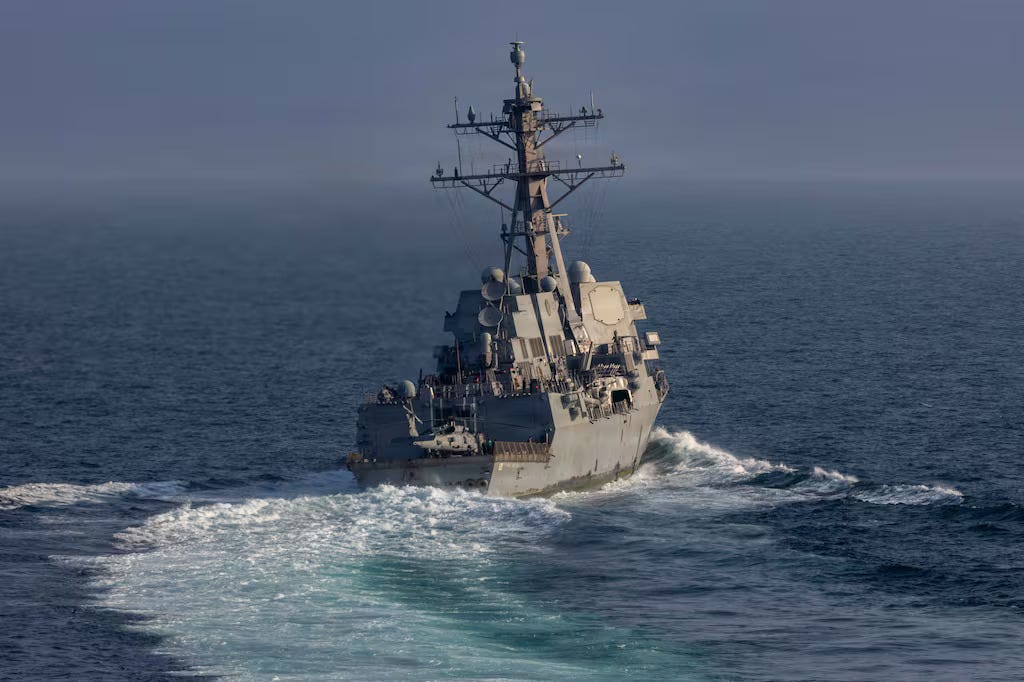
That is a fundamentally different situation.
We moved from a managed disruption to an actual closure. And the numbers tell you exactly how much that matters.
A 10% reduction in world oil supply, which is roughly what the toll booth arrangement produced, was manageable. The IEA Member countries could have temporarily released 400 million barrels of oil reserves to cover it:
Now we’re looking at a 20 to 25% reduction in daily supply from the blockade standoff.
With global consumption estimated at 106 million barrels per day, that’s a shortfall of 21 to 27 million barrels every single day.
No country is going to deplete their entire strategic reserve to cover that.
Iran has the “upper hand” right now
Here’s what most of the media hasn’t told you.
The US and Trump set the deadline on the ceasefire. It was supposed to expire Wednesday, April 22.
Iran simply refused to show up. US Vice President JD Vance was supposed to be making his way to Pakistan for another round of negotiations. The Iranians ghosted him. No call. No meeting. No response.
When someone ghosts you, there’s only one interpretation: they are not interested.
Perhaps JD Vance hasn’t experienced modern dating.
The US has since backed off, claiming the ceasefire will extend indefinitely. Meanwhile, Trump continues posting on social media every day. The Iranians continue to give the cold shoulder.
One side is broadcasting. The other side isn’t listening.
So what happens next?
Contrary to the “unpredictable” persona Trump has cultivated, in some ways he is entirely predictable.
His patience has a short shelf life.
I believe he is buying time right now, specifically to allow more US troops and assets to position in the Middle East.
We wrote about the likelihood of a ground deployment here: https://www.ecresearchgroup.com/p/watch-what-they-do-not-what-they
His likely next target is Kharg Island.
Kharg handles roughly 90 percent of Iran’s crude exports. Trump has already dropped hints publicly:
“Maybe we take Kharg Island, maybe we don’t. We have a lot of options.”
Source: https://www.cfr.org/articles/kharg-island-irans-oil-lifeline-and-a-tempting-u-s-target
That’s one way to get someone to call you back after being ghosted. Cut off the power and gas to their house.
What to do as investors?
I’m mostly sitting still.
We’ve been conditioned to believe that action creates results. That’s true for many situations:
Starting a business
Buying assets at depressed prices
But this moment is different.
The market has recovered at the fastest pace in 100 years. Meanwhile, the risks underneath this recovery are not decreasing.
They are increasing. Every week, the geopolitical picture gets more complicated. Every day the blockade continues, the supply math gets worse.
And yet, the market seems to have forgotten that risk exists.
That’s what a bubble feels like from the inside. Everything looks fine. Prices keep climbing. The situations are deteriorating, but the market shrugs. Until one day, it doesn’t.
A bubble gets its name for a reason. Eventually, it bursts.
For now, I am doing what many smart money is doing: holding an outsized position in cash and cash-like investments. Waiting for the market to finally catch up to reality.
Everything unfolding in the Strait of Hormuz only makes me more bullish on gold over the long term.
We are looking at higher inflation ahead.
We are looking at a potential slow down in global economy from oil supply constraint.
The disconnection between risk and reward won’t last forever. It never does.
If you like my work, I invite you to share it with others.
Eric Chang
Calgary, Alberta, Canada
April 22, 2026
Copyright © 2026 EC Research Group.
No part of this publication may be reproduced, distributed, or transmitted in any form or by any means, including photocopying, recording, or other electronic or mechanical methods, without the prior written permission of the publisher, except in the case of brief quotations embodied in critical reviews and certain other noncommercial uses permitted by copyright law.
The information provided herein is believed to be accurate and reliable, but EC Research Group does not guarantee its accuracy or completeness. The content is for informational purposes only and is not intended to be a substitute for professional financial advice. EC Research Group is not a financial advisor and does not provide personalized financial advice. The views and opinions expressed in this publication are those of the author and do not necessarily reflect the official policy or position of EC Research Group. The content may be subject to change without notice and may become outdated over time. EC Research Group is under no obligation to update or revise any information presented herein.
Investments involve risks, and individuals should consult with a qualified financial advisor before making any investment decisions. Prospective investors should carefully consider the investment objectives, risks, charges, and expenses of any investment before investing.